



One Planting, Two Harvests: AI Heat Stroke Prevention, Underwater Drones—The ‘Unassuming Technologies’ of Setouchi are Quietly Transforming the Field

Related Articles
One does not need to be flashy. Yet, the field is starting to turn.
In the Setouchi area, several technologies are simultaneously coming into play. The regenerative double cropping in Onomichi City, AI heat stroke risk analysis at construction sites in Okayama City, and infrastructure inspections using underwater drones in Iwakuni City—none of these technologies are the kind that make headlines. What they have in common is that they are quietly establishing themselves in ‘labor-short fields’ as extensions of existing systems.
This is not about startup funding amounts or new models of generative AI. It’s about the young shoots sprouting from the base of rice plants, sensors wrapped around workers’ arms, and small devices crawling along the docks. Who are these unassuming technologies making easier? We traced the structure behind it.
—
Onomichi City, Michizono Town—Harvesting Twice from One Planting
In the Imatsuno area of Michizono Town, Onomichi City, the community corporation “Imatsuno Higashi” is engaged in a method of rice cultivation known as regenerative double cropping.
Here’s how it works. In conventional rice farming, fields lie fallow until the following spring after harvesting in autumn. In regenerative double cropping, after the first harvest, the “hikobae” (young shoots) that sprout from the stubble are nurtured for a second harvest. Planting occurs only once a year, and both seedling preparation and transplanting are completed in one go. The difficulty of lower autumn temperatures due to global warming has become a tailwind for securing the growing period of hikobae. While it is often said that climate change is being “turned on its head,” it is more accurate to say that existing farming methods have been reorganized within the changed conditions.
What is noteworthy is that this method operates not as an individual skill of “hardworking farmers” but as a structured system within a community corporation. At Imatsuno Higashi, members share responsibilities for planting, water management, and harvesting, and they are also beginning to standardize the timing for additional fertilization and water management necessary for the second harvest. Translating individual experiential knowledge into organizational procedures—this painstaking work supports reproducibility.
According to test data from Hiroshima Prefecture, the second harvest yield from regenerative double cropping is estimated to be about 30-50% of the first. If the first harvest yields around 480 kg per 10 ares, the second would yield approximately 150-240 kg. Combined, this results in a definite increase in yield compared to single cropping. The structure of increasing the number of harvests without increasing planting frequency could be a practical option for improving returns per labor input in aging, depopulated hilly and mountainous areas.
However, there are challenges. The second rice harvest tends to have smaller grains, which may lower its grade as a staple food. Whether outlets for feed rice or processed rice can be secured will determine the sustainability of this system. It’s not just about technology; the entire “system” including distribution design is being questioned.
—
Okayama City—AI is Watching the “Relationship Between Environment and Body” Rather Than “Body Condition”
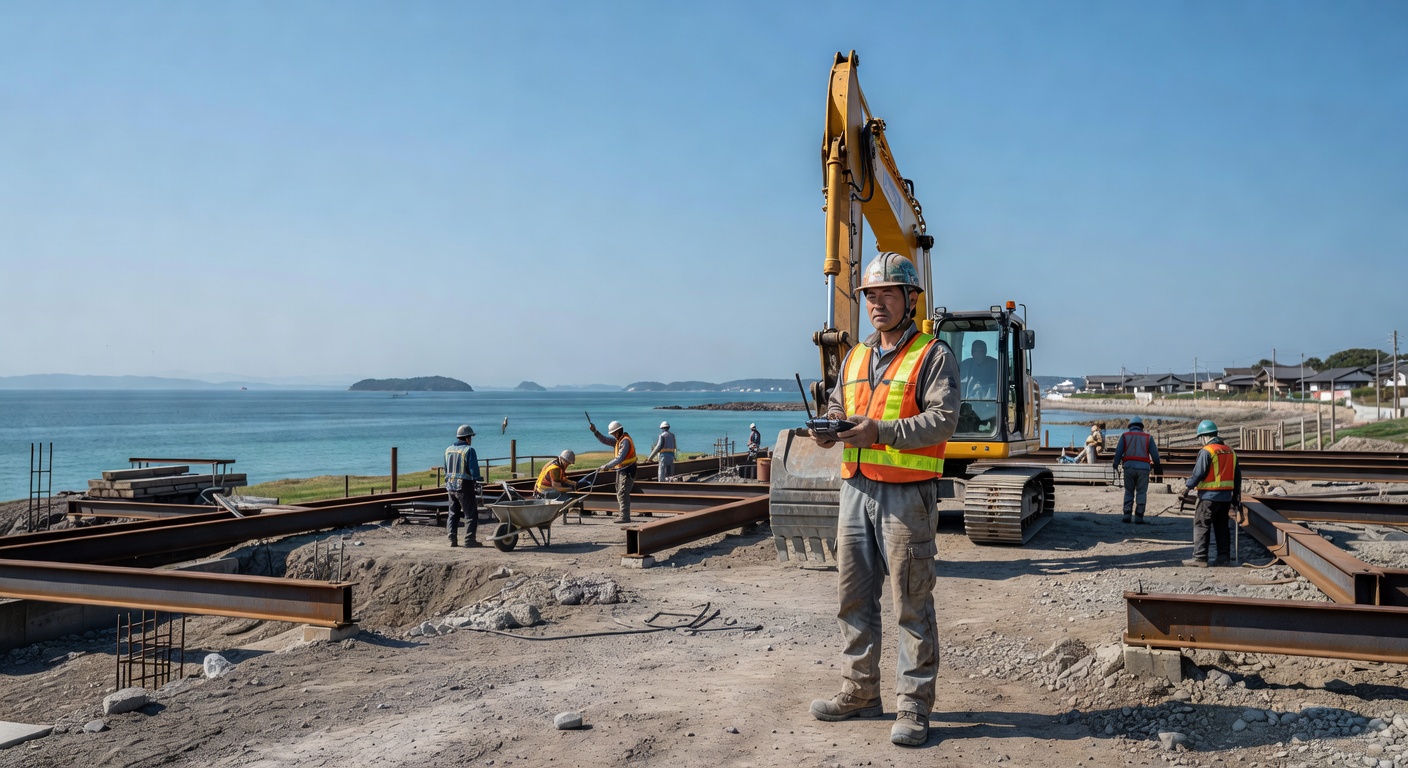
At construction sites in Okayama City, the introduction of an AI heat stroke risk analysis system is underway. Developed by a local company, this system combines wearable sensors and environmental sensors to estimate the heat stroke risk for each worker in real-time.
It’s important to note that this system does not operate on a simple structure of “measuring body temperature and issuing warnings.” The sensors collect not only physical data such as skin temperature, heart rate, and activity level but also environmental data such as WBGT (Wet Bulb Globe Temperature), air temperature, humidity, and radiant heat at the site. The AI combines these to calculate individual risk scores. Even at the same temperature of 35 degrees Celsius, a worker who had poor sleep the night before will have a different risk level than one who rested well. Capturing that difference is the design philosophy of this system.
The number of heat stroke-related injuries and fatalities in the construction industry consistently ranks high in statistics from the Ministry of Health, Labour and Welfare. In 2023, there were 1,106 heat stroke casualties across all industries, with construction being one of the most affected sectors. The traditional method of a supervisor noticing, “That person looks pale,” has its limits, especially since supervisors are also exposed to the heat. Transitioning from subjective observation to data-driven structural detection is an attempt to fundamentally change the safety management system itself.
The introduction cost is said to be in the range of several hundred thousand yen per site, designed with an awareness that it is accessible not only to large general contractors but also to local small and medium-sized construction companies. One site manager mentioned, “It feels less like we’ve added expensive machinery and more like we’ve gained another basis for judgment.” When technology enters the field, whether it is accepted as a “tool” depends more on how little it disrupts existing workflows than on its price.
—
Iwakuni City—Underwater Drones Open Up “Inaccessible Areas”
The “Iwakuni Ocean Tech Days” held in Iwakuni City, Yamaguchi Prefecture, attracted attention as an exhibition and demonstration event for marine technology. One technology that garnered interest among practitioners was infrastructure inspections using underwater drones (ROVs: remotely operated vehicles).
Structures underwater, such as port walls, submerged parts of bridges, and nets in aquaculture pens, require regular inspections but have traditionally relied on divers for visual confirmation. The aging of divers and labor shortages are serious issues, and a survey by the Ministry of Land, Infrastructure, Transport and Tourism has pointed out delays in the inspection of aging port facilities. Underwater drones are positioned as a means to circumvent the physical constraints of “not having enough divers.”
Most drones are about 50 cm long and may include high-resolution cameras, sonar, and underwater positioning systems. They are operated via a controller and monitor, allowing use without diving qualifications. The price range for each unit varies from several hundred thousand to a few million yen, but for inspection purposes, relatively inexpensive models can suffice. Compared to the cost of a single dive inspection, multiple uses can recoup the investment.
However, underwater drones do not “replace” divers. Visibility in murky waters, access to narrow areas, and tactile inspections remain domains where machines are hard to substitute. The key is to differentiate between areas where divers should dive and those where drones can suffice, thereby redesigning the structure to concentrate limited human resources where they are truly needed.
The location of Iwakuni also holds significance. The Seto Inland Sea is relatively calm, providing favorable operational conditions for underwater drones. Additionally, Iwakuni has a history of infrastructure technology related to U.S. military bases, and its potential as a testing ground for marine technology has been noted. The event itself is tied to the region’s technological foundation.
—
Common Structures Underlying the Three Technologies
Regenerative double cropping in Onomichi, AI heat stroke analysis in Okayama, and underwater drones in Iwakuni. While the fields are diverse, a common design philosophy emerges when their structures are lined up.
First, they operate by “changing procedures” rather than “increasing manpower.” Regenerative double cropping increases harvests without increasing planting frequency. AI analysis improves detection accuracy without increasing the number of monitors. Underwater drones expand inspection ranges without increasing the number of divers. All of these systems produce more results with the same number of people by rearranging processes rather than “supplementing” the insufficient workforce.
Second, they are integrated into existing fields in a “grafting” manner. They do not demand entirely new operations but insert a process or tool into the current workflow. This is why they are accepted in the field. In the introduction of technology, this “grafting design” is a more important variable than performance.
Third, their “unassuming” nature becomes a strength. Because they do not attract much attention, they do not gather excessive expectations or investments. Improvements accumulate at a pace that fits the realities of the field. What remains after flashy technologies have cycled through may be these unassuming systems.
—
What to Watch Going Forward
For regenerative double cropping, whether the marketing and quality evaluation systems for the second harvest rice will be established. For AI heat stroke analysis, whether the accumulated data will lead to a review of cross-industry safety standards. For underwater drones, whether the accumulation of inspection data will evolve into a preventive maintenance model for infrastructure.
In all cases, we are entering a phase where the overall “system” into which the technology is incorporated is being questioned, rather than the performance of the technology itself.
The technologies operating in the Setouchi field are all small. However, those that are reliably functioning while remaining small possess a quiet strength before expansion. They slightly free someone’s hands—this accumulation connects the region’s activities to the next season.


 JA
JA EN
EN