



Artificial Seedling Cultivation of Oysters, PTA Pool Opening, and Shopping Street Crafting – “Without Someone Organizing, Nothing Works” in Setouchi’s Summer

Related Articles
Visible Arrangements of Summer – Three Scenes from Setouchi
As summer arrives, those who are part of the “operational side” in Setouchi’s coastal areas quietly begin to move. There are people hanging scallop shells in the sea, others measuring chlorine levels in elementary school pools, and some transforming everyday items into different shapes at the shopping street. These are all stories of the mundane yet essential arrangements that lie behind vibrant scenes.
The artificial seedling cultivation research aimed at recovering Hiroshima’s oyster production, the reopening of elementary school pools for the first time in seven years, and the traditional shopping street event of “crafting” – when we line up these three scenes, a common structure emerges. Nothing can proceed without someone setting up the framework, and that “someone” usually does not step into the spotlight.
—
Artificial Seedling Cultivation – Graduate Students Tracking Ocean Anomalies with Numbers
From 2024 to 2025, Hiroshima Prefecture faced a severe decline in oyster production. As the largest production area, accounting for about 60% of the national oyster output, Hiroshima has seen a significant drop in the success rate of natural seedling cultivation – a method where oyster larvae naturally attach to scallop shells suspended in the sea – due to rising sea temperatures and decreasing nutrient salts.
In the fishing grounds of Aki-Tsu Town, a research team from Hiroshima University’s graduate school continues its investigations aimed at recovery. Specifically, they are recording changes over time in the quantity of phytoplankton in seawater, water temperature, and salinity to quantitatively understand when and at what depths oyster larvae are likely to attach. They install seedling collectors at various depths and retrieve them periodically to count the number of attachments. This painstaking work is crucial; without accumulating these numbers, there is no basis for deciding “when and where to hang them”.
What’s important here is that the graduate students are not acting alone. The local fishermen’s experiential knowledge is indispensable in selecting the survey areas. “This area has strong currents, making it hard for larvae to settle,” or “Last year, this spot had good attachment rates” – such insights directly influence the design of sampling points. The moment researchers’ analytical methods align with fishermen’s practical sense, the accuracy of the investigation increases.
Once the technology for artificial seedling cultivation is established, it will allow for the securement of seed oysters without being affected by natural larval occurrences. The total annual production value of oysters in Hiroshima Prefecture is estimated at around 20 billion yen, and the stable supply of “seed” that supports this foundation is a matter of sustainability for the industry itself. Graduate students collect seawater, and fishermen set out to sea. This cycle holds the future of the production area.
—
Pool Opening After Seven Years – The PTA’s Engineered “Operational System”
In the summer of 2025, the pool at Seno Elementary School in Aki Ward, Hiroshima City, reopened for the first time in seven years.
Several factors contributed to the seven-year hiatus. It became difficult to secure lifeguards, the standards for addressing heatstroke risks tightened, and activities were curtailed due to the COVID-19 pandemic. It wasn’t just one reason; multiple conditions combined led to the ongoing decision to “not proceed”. Restarting a system that has come to a halt requires more energy than starting anew.
The key to reopening was that the PTA parents completely reorganized the lifeguard shift schedule from scratch. Parents take turns serving as lifeguards, clearly defining the criteria for cancellation during heatstroke alerts, and establishing emergency communication flows. The parents standing by the pool are responsible not only for their own children but for the safety of all children present that day. This premise of “watching over others’ children” is essential for the system to function.
On the first day of reopening, the cheers of children jumping into the pool echoed across the schoolyard. Behind the scenes, there were parents checking the registration list, others recording water and air temperatures, and some transporting coolers to shaded areas. The smiles of the children are the result of many adults taking on the “arrangements”.
Nationally, the trend is increasing for municipalities to discontinue summer openings of school pools. The costs of lifeguards, facility aging, and safety management responsibilities are all challenges that are not easily resolved. The case of Seno Elementary School could serve as a model, demonstrating how local parents redesigned the system to achieve reopening. However, it also represents a structure that relies on “the goodwill of parents”. Whether this system can be sustained next year or the year after is still uncertain.
—
Shopping Street Crafting – A Festival Where Everyday Items Become “Something Else”
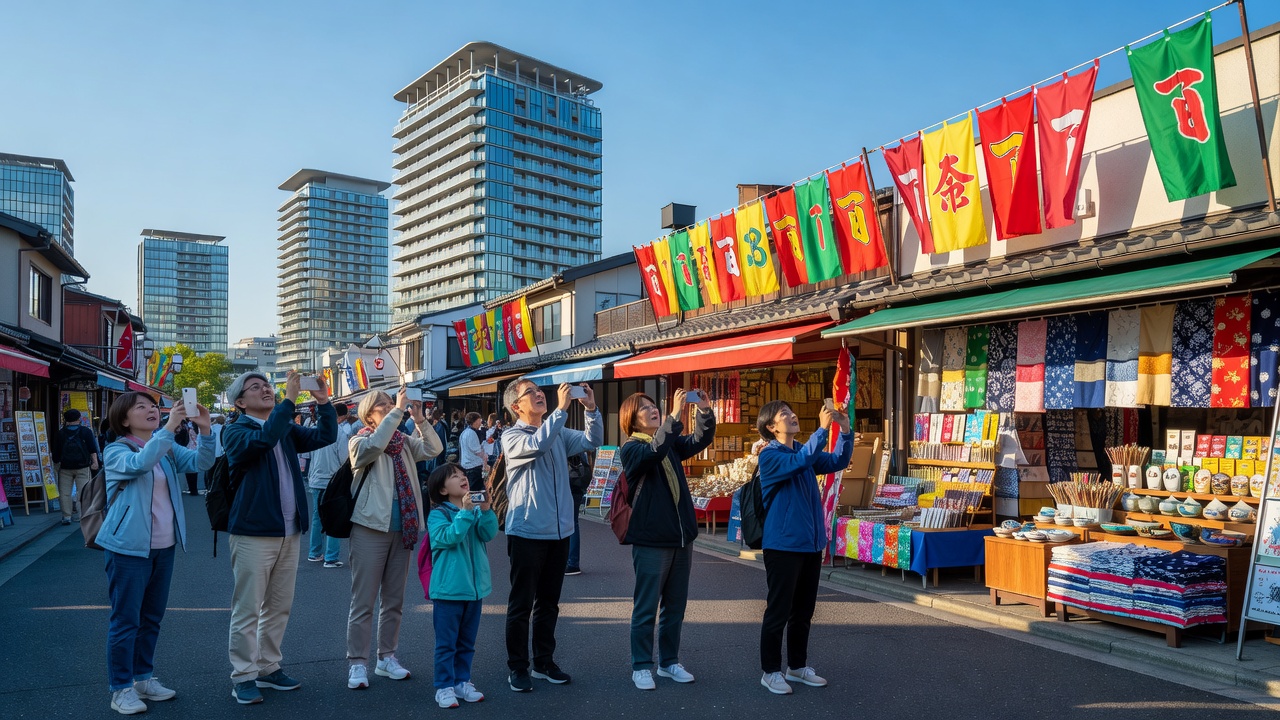
In the shopping street of Aki-Tsu Town, Higashi-Hiroshima City, the annual event of “crafting” is held during the summer. Crafting involves a traditional play where everyday items and products are used to create shapes that resemble something else, displayed at storefronts. Clothespins are used to create a phoenix. Soy sauce bottles are lined up to build a castle. The gap between the “original use” of the materials and their “crafted appearance” is at the core of the fun.
Behind this event, there are also arrangements. Each store decides on a theme, gathers materials, secures production time, and coordinates the timing of the displays. The shopping street association adjusts the overall schedule and promotes the event through social media and flyers. If only one store decorates, it does not become an “event”. When multiple stores display at the same time, it creates anticipation for passersby, leading to foot traffic.
Another power of crafting is that it provides shop owners with an opportunity to view their own products from a “different perspective”. They reconsider the items they handle daily as materials for creation. This shift in perspective itself opens a small window in the daily routine of business. When local children talk about how “that fishmonger’s work was amazing”, the relationship between the store and the people shifts slightly from “buying and selling”. This shift updates the significance of the shopping street as a place.
—
Common Structures in the Three Scenes
Artificial seedling cultivation, the opening of elementary school pools, and shopping street crafting. While differing in scale and field, these three scenes share a common structure.
First, they are all things that “aren’t immediately necessary”. Even if natural seedling cultivation fails, oysters won’t disappear this year. If the pool isn’t opened, children can play elsewhere. If crafting is discontinued, the shopping street won’t vanish overnight. However, once discontinued, certain things begin to be lost gradually. The inheritance of skills, connections between children and the community, and the cultural richness of the shopping street – these are all difficult to quantify, but once interrupted, it can take years to recover.
Second, they all require “more than one person to operate”. Graduate students alone cannot select the sea areas. A single parent cannot establish a lifeguard system. One store alone cannot generate foot traffic. It is only when individuals in different positions take on their respective roles that the whole can begin to move.
Third, those who make arrangements tend to be “unnoticed”. What makes the news are the quantities of oysters shipped, the smiling faces of children playing in the pool, and the completed crafted items. However, behind those scenes are hands collecting seawater, creating shift schedules, and coordinating schedules.
—
Who Does This Make Comfortable?
It is easy to summarize with phrases like “community bonds” or “the importance of cooperation”. However, I want to ask more specifically – who do these systems make comfortable?
If artificial seedling cultivation gets on track, fishermen will find it easier without having to worry about the natural occurrence of larvae. If the pool opening system is established, parents searching for a place for their children during summer vacation will find it easier. If crafting continues, residents will feel that “there’s something to find in that shopping street”.
In each case, as the system operates, the burden on specific individuals is lightened, allowing them to reach for other things. That is what a system is.
The summer in Setouchi is being managed by those who make arrangements. Before their hands stop, it is crucial to gradually organize the side of the system – this is the mundane yet urgent task visible from this summer’s scenes.


 JA
JA EN
EN