



A 440-Year-Old Vinegar Brewery, Seeds from 48 Years Ago, and a 10-Year Paper Cutout: How ‘Taking Time’ Becomes an Economy in a Small Setting in Setouchi

Related Articles
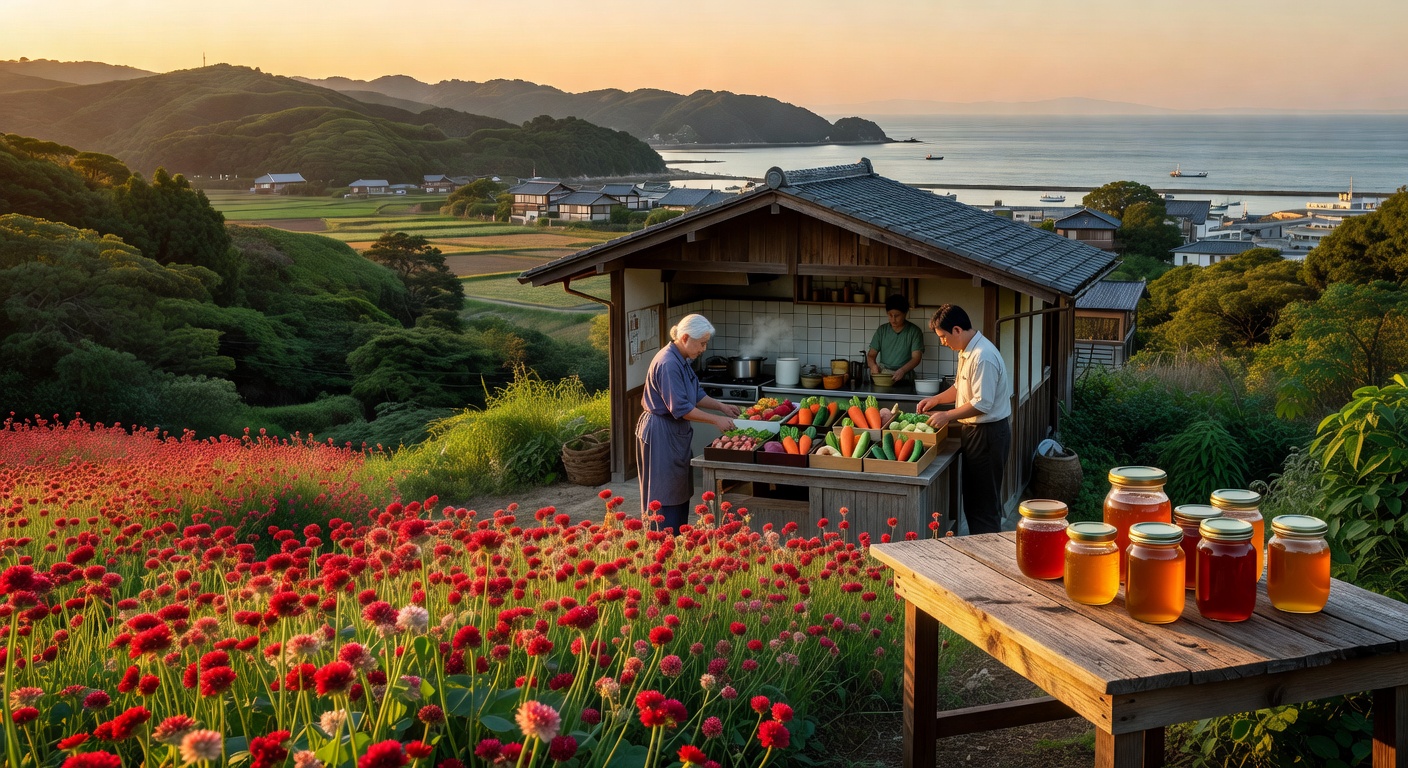
Outside of Speed, Price Tags Are Starting to Appear
In a back alley of Onomichi, there is a vinegar brewery that has been in operation for 440 years. In the refrigerator of the Hiroshima City Botanical Garden, seeds collected 48 years ago lie dormant. In a room in Asaminami Ward, a single artist has been recreating the Tōkaidō Fifty-Three Stations in paper cutouts over the course of ten years.
What these three settings have in common is the fact that someone chose to “wait.” It is neither efficiency nor innovation—simply, they did not let go of time. And that decision is now quietly beginning to connect with the economy.
“Slowness” is not a weakness; it becomes an entry barrier that cannot be easily replicated. From this small setting in Setouchi, we can read that structure.
—
The “Fig Vinegar” Born from a 440-Year-Old Fermentation Tank — Onomichi Vinegar’s New Creation
Onomichi Vinegar is said to have been founded during the Tenshō era and has been producing vinegar for about 440 years. The ecosystem of acetic acid bacteria that has settled in the brewery itself is an asset that cannot be replicated elsewhere.
From this brewery, a new product, “Fig Vinegar,” has emerged. The raw material is the skin of locally grown figs from Onomichi. The flesh is often used for jams and sweets, while the skin, which was traditionally discarded, has been utilized as a raw material for vinegar. The fermentation and aging process takes about six months. The result is a harmonious blend of sweetness and acidity, suitable for dressings and carbonated drinks.
What is noteworthy here is the structure in which the “discarded skin” meets the “440-year-old bacteria.” While fig skins can be obtained anywhere, the technique of brewing vinegar over six months can also be found in other breweries. However, the microbial community that has settled in the brewery over 440 years—this cannot be purchased through capital investment. Time itself has become the manufacturing apparatus.
In local restaurants, menus using this fig vinegar are gradually beginning to spread. The vinegar brewery, farmers, and restaurants are interconnected. While it may be easy to label this as local production for local consumption, the reality is that a new cycle has emerged within the community through the meeting of “discarded materials” and “irreplaceable bacteria.” The mechanism is beautifully structured.
—
Seeds from 48 Years Ago Sprout — Hiroshima City Botanical Garden, Sprouting of Yachishajin
The Hiroshima City Botanical Garden has successfully sprouted seeds of the endangered species “Yachishajin.” What is remarkable is that these seeds were collected 48 years ago.
Yachishajin is a perennial plant in the bellflower family, and its natural habitat has drastically decreased due to the reduction of wetland environments. The botanical garden collected seeds in the 1970s and has been preserving them in cold storage. “For the day when the conditions for germination are met”—the name of the person who made that decision back then is not prominently featured in the reports. However, without someone deciding 48 years ago not to “discard” them, this sprouting would not have happened.
Long-term seed preservation and germination testing require a diligent accumulation of techniques, including temperature control, moisture content adjustment, and germination promotion treatments. The 48 years is not merely the period during which the seeds lay dormant. During that time, researchers changed, preservation techniques were updated, and understanding of the ecosystem deepened. It may be more accurate to say that it was not the seeds that were “waiting,” but rather the people who have “caught up.”
What this project illustrates is that conservation is not just about “protecting” but also about “passing on.” The decision made 48 years ago has been received by current technology. Here, there is a structure that transcends individual capabilities; it is an organizational mechanism that has absorbed a half-century time gap. The design of the seed bank has bridged that temporal divide. It was not just one person who worked hard for 48 years—rather, the system has passed on time.
In the context of environmental education, this case holds significant meaning. A specific scene—”the seeds someone put in the refrigerator 48 years ago have sprouted this year”—is far more impactful than an abstract message like “let’s protect endangered species.”
—
Ten Years, One Person, Tōkaidō Fifty-Three Stations — Paper Cutout Exhibition in Asaminami Ward
In Asaminami Ward, Hiroshima City, an exhibition has been held showcasing paper cutouts recreating the Tōkaidō Fifty-Three Stations. This was created by a single artist and took ten years to complete.
Hiroshige Utagawa’s Tōkaidō Fifty-Three Stations consists of 55 images. On average, more than two months were spent on each piece. The technique of paper cutout does not add to the paper but reveals images by subtracting from it. Once a line is cut, it cannot be restored. Completing 55 pieces under the tension of not being able to redo them is both a technical feat and a testament to the accumulation of time itself.
Visitors to the exhibition likely stop in front of each piece for a few seconds to a few minutes. The months the artist poured into each piece contrast sharply with the few minutes the viewer spends observing. This asymmetry is the unique gravity that handmade works possess. The moment the information “it took ten years” is added, the perception of the same paper cutout changes. Time reinforces the value from the outside of the work.
This exhibition is free to enter and open to the community. The fact that it is held in a local cultural facility, rather than a commercial gallery, should not be overlooked. A ten-year production period is difficult to justify under market logic. However, when viewed as a form of cultural capital for the community, the mere fact that something “only seen here” has been created holds significance.
—
The Same Structure Reflected in Three Settings
440 years, 48 years, 10 years. While the scales differ, there is a common structure among these three settings.
First, time serves as an entry barrier. The microbial community at Onomichi Vinegar cannot be replicated through capital investment. Seeds from 48 years ago cannot be collected anew. Ten years of paper cutouts cannot be replicated in context, even if produced by AI. All of these represent values that cannot be caught up with by simply investing money later.
Second, it is not individual effort but the system that supports time. The vinegar brewery has a building and methods that harbor bacteria. The seed bank has systems for preservation, management, and succession. The paper cutout artist has a living foundation and a venue that enabled ten years of production. It is not a matter of individual tenacity; rather, it is the existence of a “sustainable structure” that has transformed time into value.
Third, circulation is being created within the community. Fig skins move from local farmers to the vinegar brewery, and vinegar goes to restaurants. The sprouting of seeds reaches the field of environmental education. The paper cutout exhibition is freely open in a local cultural facility, becoming an experience for visitors. None of these are aimed at the large markets of Tokyo or Osaka. They are small but surely circulating within the community.
In a speed-driven economy, claiming that “slowness” becomes a weapon may be a bit reckless. More accurately, it is the order of “the economy catching up with the settings that did not let go of time.” It was not a deliberate choice to select slowness as a differentiation strategy from the beginning. As a result, they found themselves in a place that could not be reached through speed.
—
What to Watch for Going Forward
How far will Onomichi Vinegar’s fig vinegar reach beyond local restaurants? Will there come a day when Yachishajin seedlings return to their natural habitat? In what form will the works from the paper cutout exhibition be preserved next?
All of these questions cannot be measured by short-term sales or visitor numbers. However, when viewed from the perspective of “who does this make easier?” the outlines of answers become somewhat clearer. If discarded skins become raw materials, farmers will benefit. If successful cases of the seed bank increase, the next generation of researchers will find it easier to make decisions. An exhibition that is freely open to the community lowers the barriers to cultural engagement.
Things that take time reduce someone’s effort and expand someone’s options. There is no flashiness. Yet, we have always referred to places where such small circulations quietly continue to turn as “rich communities.”
The three settings in Setouchi convey this—not in words, but through the thickness of 440 years, 48 years, and 10 years.


 JA
JA EN
EN