



The One Who Reads 816 Names, The One Who Writes a List of 4,393 Names—When “The Handwork of Memory” Becomes a System

Related Articles

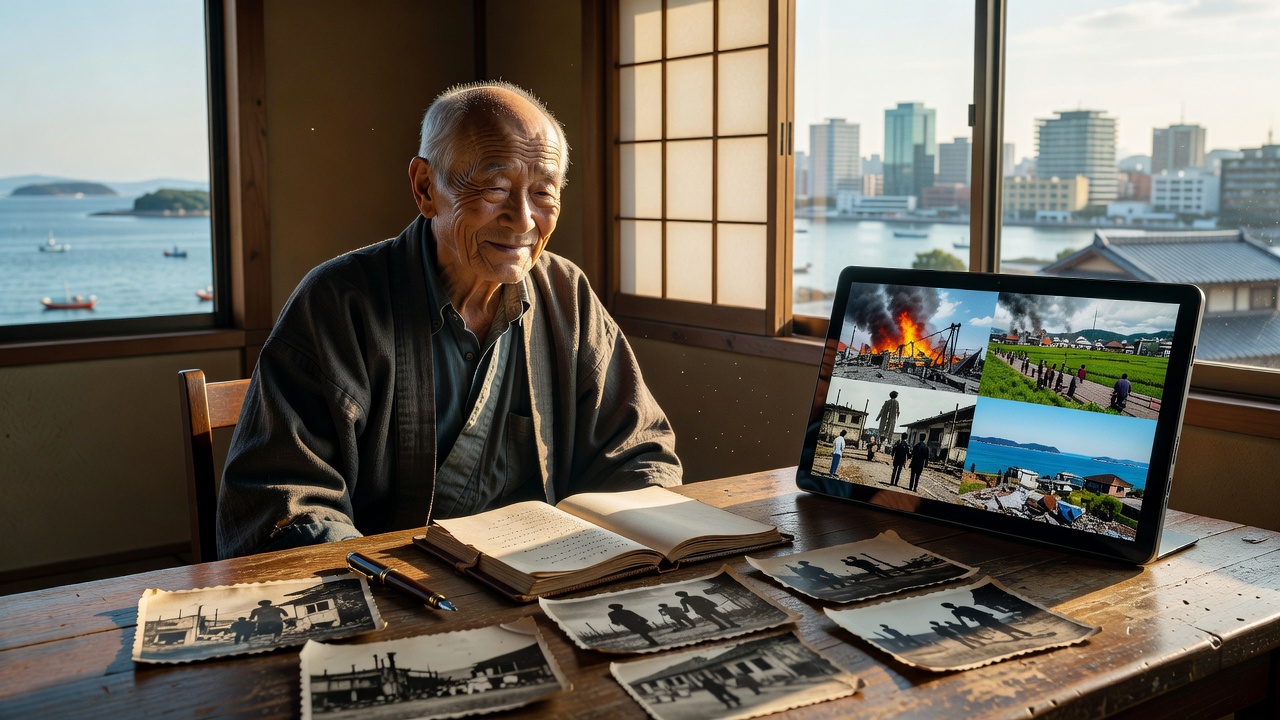
Voice and Pen: What They Carry
In the summer of Hiroshima, two forms of “handwork” are quietly at play.
One involves reading aloud the names of 816 individuals in front of the Atomic Bomb Memorial. This act returns the names of those whose remains have no one to claim them back to the air through voice. The other is the handwritten recording of 4,393 names in the list of atomic bomb victims. This year, the youngest scribe is said to be just 16 years old.
For the first time this year, the memorial service at Hiroshima Second Junior High School was live-streamed. This decision was prompted by a series of heatstroke incidents among attendees last year. A practical judgment to address the heat opened a channel for participation that allows people to engage without being physically present.
These three events operate in different contexts. Yet, when placed side by side, a single question arises—how much of the act of memory preservation can be entrusted to a system? And how much can that system bear the warmth of human touch?
The Act of Calling Out 816 Names
Among the remains housed at the memorial, 816 are unclaimed. Every August, each name is read aloud, one by one.
Let’s consider the structure of this act. Reading names is not merely a transmission of information. It is a process of breaking down the number 816 back into “one”. It returns the statistic of death to “someone” once more. Each time a name is etched into the air by voice, abstraction is pulled back into the concrete.
Reading takes time. The physical time it takes to voice each of the 816 names—this “taking time” itself is likely the essence of this ritual. It cannot be made efficient. It cannot be shortened. There exists a form of memory that can only be realized by offering time through the body.
Moreover, this act is only realized when “someone voices it” each year. Even if the person reading changes, the names remain the same. However, the voices are different each year. The personal nature of the act and its institutional continuity coexist here without contradiction.
What the 16-Year-Old Pen Takes On
The recording of the atomic bomb victim list is conducted annually by Hiroshima City. Names of those confirmed deceased in the past year or newly reported are added and presented at the Peace Memorial Ceremony on August 6. This year, the list includes 4,393 names, and among the recorders is a 16-year-old high school student.
What is noteworthy here is not just the fact that it is a “16-year-old who wrote it,” but that this task continues to maintain the form of “handwritten by selected individuals.”
The list is not a database. It is not a printed document. Each year, it is written by hand, stroke by stroke. Imagine the volume of work involved in writing 4,393 names by hand. If it takes a few minutes per name, that amounts to hundreds of hours in simple calculations. Although multiple recorders share the burden, the effort is immense.
Why is it handwritten? Perhaps it is because the physical act of “writing” imbues the weight of memory within it. Each time the scribe draws a stroke, they are compelled to confront that name. The pressure of the pen, the density of the ink, the friction with the paper—what remains is not information, but traces. Through the human hand, names transform from “data” to “records.”
The fact that a 16-year-old undertakes this task signifies that the recording system has begun to function across generations. A generation without direct experience of the bombing uses their bodies to write names. The design of inheritance is structured not as a memory of experience, but as a memory of action—this can be interpreted.
The Circuit Opened by Live Streaming
The memorial service at Hiroshima Second Junior High School is an event to mourn the students who were exposed to the atomic bomb while engaged in building relocation work on August 6, 1945. This year, live streaming was introduced for the first time.
The catalyst for this was the occurrence of heatstroke among attendees at last year’s memorial service. The temperature in Hiroshima in August has been rising year by year, and participating in an outdoor ceremony for extended periods poses a significant physical burden for elderly family members. Live streaming was chosen as a response to this practical challenge.
What emerges here is that the motivation for introducing technology lies not in “innovation” but in “continuation.” Live streaming was implemented not to change the memorial service, but to sustain it. By allowing those who can no longer attend to have the option to “participate without being present,” the sustainability of the memorial service itself has increased.
At the same time, live streaming inadvertently opens another circuit. People who are geographically distant—such as children or grandchildren of families who have left Hiroshima, or those who are learning about the memorial service for the first time—can now connect to the event through a screen. A practical decision made for heat management has, as a result, broadened the scope of participation. This is a moment where the system functions beyond the intentions of its designers.
However, participation through a screen is not the same as standing in the heat. There is something irreplaceable about the physical burden of attending in person. Rather than distinguishing between “real” and “fake,” it is likely more accurate to view it as a state where different layers of participation coexist.
Does the System Erase or Preserve the “Hand”?
Let us place these three events side by side.
The reading of 816 names is an annual ritual that relies on the personal bodily act of voice. The recording of the list intentionally retains the inefficiency of handwriting while being operated as an administrative system. Live streaming expands the form of participation through technology while presupposing the face-to-face ritual of the memorial service.
None of these oppose systematization and personal touch. Rather, they seek to maintain the warmth of memory by incorporating the “hand” into the system.
This is not limited to the inheritance of memory. The question of how to sustain “work that cannot exist without human hands” exists in various fields, such as local festivals, the transmission of traditional crafts, or caregiving.
What is important is when the purpose of systematization is not to make “hands unnecessary” but to create an environment where “hands can continue to reach out.” Switching the recording of the list to printing would increase efficiency. However, at that moment, the time the recorder spends confronting the names would vanish. Solely relying on live streaming would resolve the heat issue. Yet, at that point, the significance of the act of standing in that place would diminish.
The system does not erase the “hand”; rather, it exists to preserve the “hand”—this reversal is quietly occurring in the field of memory inheritance in Hiroshima.
Who Does This Ease?
Finally, I would like to leave one question.
Live streaming has eased the burden for families who can no longer stand in the heat. The recording system has provided a “gateway to involvement” for the 16-year-old scribe. The reading system prevents the remains without claimants from being forgotten.
All of these ease someone’s burden. And this “easing” is directed not towards laziness but towards enabling continuation.
In the inheritance of memory, the most dangerous thing is “disruption.” When personal handwork stops due to the aging of those who carry it or physical constraints, memory also halts. The system exists to prevent that disconnection.
The voice that reads the names of 816 individuals will emerge from someone’s throat again next year. The pen that writes the names of 4,393 individuals will be held by someone’s hand again next year. The footage of the memorial service will be displayed on some screen again next year.
The system supports the hand, the hand supports memory, and memory calls forth the next hand. Within that continuity, this year, the 16-year-old pen added one stroke.


 JA
JA EN
EN