



2.12 million foreign guests, 2.58 million visitors to the Atomic Bomb Museum, and 620,000 users of the Senkoji Ropeway—Where is the boundary between ‘transit’ and ‘stay’ behind the numbers?

Related Articles

Three Numbers Reflecting the Current State of Hiroshima Tourism
2.12 million, 2.58 million, 620,000—.
The tourism statistics for 2024 released by Hiroshima Prefecture feature three numbers, each with a different significance. The total number of foreign overnight guests reached 2,120,570 (according to the Japan Tourism Agency’s “Accommodation Travel Statistics Survey”), the annual number of visitors to the Atomic Bomb Museum was 2,582,826 (as reported by the Hiroshima Peace Memorial Museum), and the annual users of the Onomichi Senkoji Ropeway totaled 619,339 (as announced by Onomichi City).
Each of these figures represents a record high or is close to it. Headlines in the news feature phrases like “record high” and “V-shaped recovery.” However, simply presenting the size of these numbers does not reveal who benefits from them or where money and time are being spent. By reinterpreting these three numbers through the lens of “transit” and “stay,” structural questions about Hiroshima’s tourism begin to emerge.
—
2.12 Million ‘Staying’—How the Ratio of Visitors from Europe, America, and Australia Changes the Quality of Stay
The number of foreign overnight guests in Hiroshima Prefecture has surpassed pre-COVID levels from 2019, exceeding 2.12 million. Notably, the distribution of these guests is skewed. According to statistics from Hiroshima Prefecture, visitors from Europe, America, and Australia account for more than half of the total. In contrast to Tokyo and Osaka, which primarily attract travelers from Asia, Hiroshima clearly has a structure that favors visitors from Europe, America, and Australia.
This structure is directly linked to the quality of the stay. Generally, travelers from Europe, America, and Australia tend to have longer stays, averaging around 14 nights per trip (according to the Japan Tourism Agency’s “Consumption Trends of Foreign Visitors to Japan Survey” 2024). This is more than double the average stay of 4 to 7 nights for travelers from Asia. Longer stays lead to increased spending not only on accommodation but also on dining, transportation, and experiential consumption. Hotel representatives in Hiroshima city note, “European and American guests tend to stay multiple nights and often dine in the city for both breakfast and dinner. Patterns of one night in Miyajima and two nights in the city are becoming more common.”
However, this benefit is not evenly distributed across the prefecture. The majority of guests are concentrated in the central area of Hiroshima City and around Miyajima. The economic effects generated by the act of “staying” are geographically uneven. Behind the total of 2.12 million lies a disparity between regions that can accommodate guests and those that cannot—this is a structure that is not visible through numbers alone.
—
2.58 Million ‘Visiting’—Will Time Remain Beyond the Museum?
The annual number of visitors to the Atomic Bomb Museum exceeding 2.58 million reflects the heightened interest following the G7 Hiroshima Summit in 2023. The renewed exhibitions have also received high praise both domestically and internationally. The proportion of foreign visitors has been steadily increasing, with some years seeing it reach about 40% of the total.
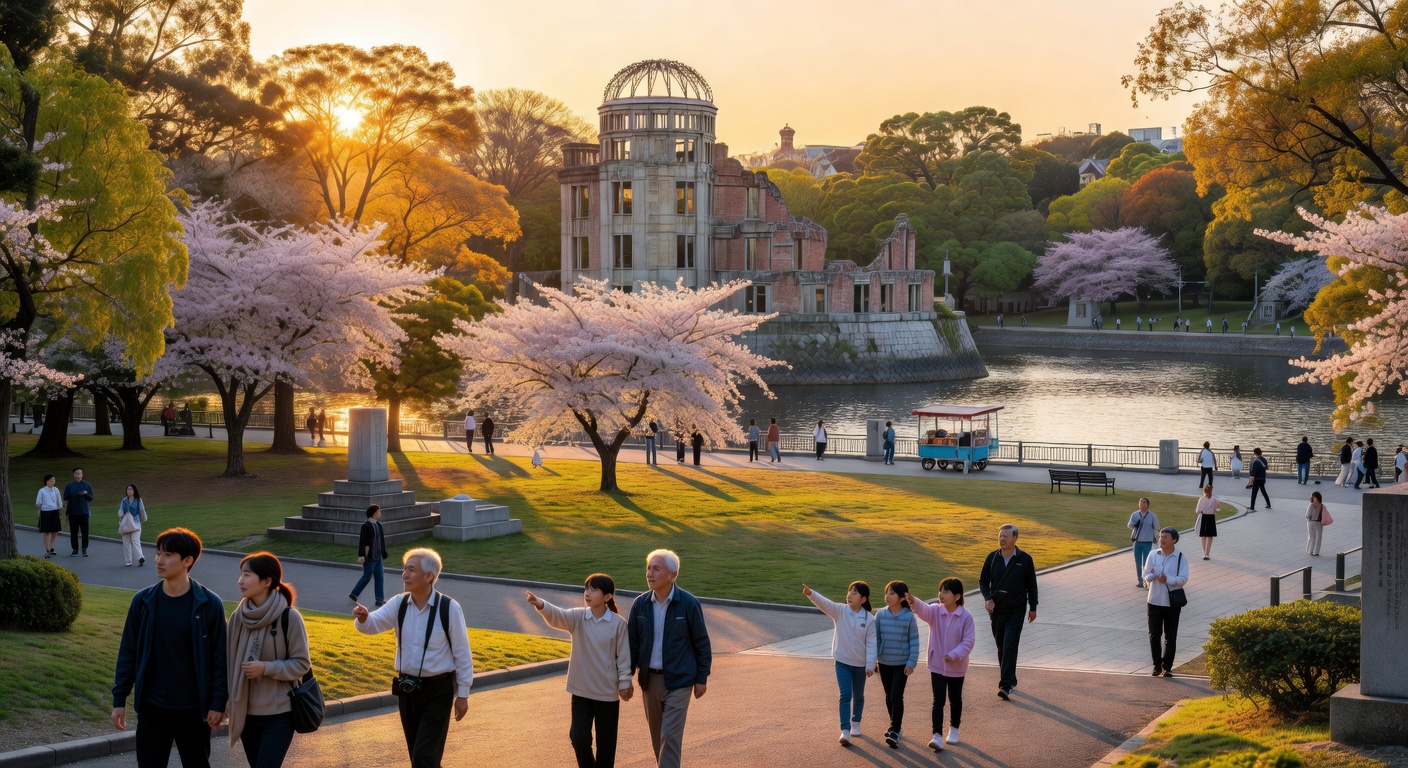
However, it is not possible to reinterpret the figure of 2.58 million as “the number of people who stayed in Hiroshima.” The average time spent in the museum is estimated to be around one and a half to two hours. Many visitors spend half a day, including the Peace Memorial Park, and then their subsequent actions diverge. Some head to Miyajima, others take the Shinkansen to the next city, and some dine in local restaurants.
The question is how many of the 2.58 million who visited the museum chose to have “one more meal” or “one more night” in Hiroshima City. According to a tourism dynamics survey conducted by Hiroshima City, the average stay time for day-trippers is about 5 hours, while overnight guests average only around 1.2 nights. The 2.58 million visitors to the museum demonstrate that Hiroshima has a strong appeal as a “stopover” but also reveal that it has not completely shed its character as a “transit point.”
After exiting the museum, walking along Peace Boulevard, entering alleys around Fukuro-machi, enjoying okonomiyaki at a local restaurant, and strolling through the park again the next morning—how to design this “time beyond the museum” will be key to transforming the 2.58 million into a force for the local economy.
—
620,000 ‘Passing Through’—The Day Trip Structure in Onomichi
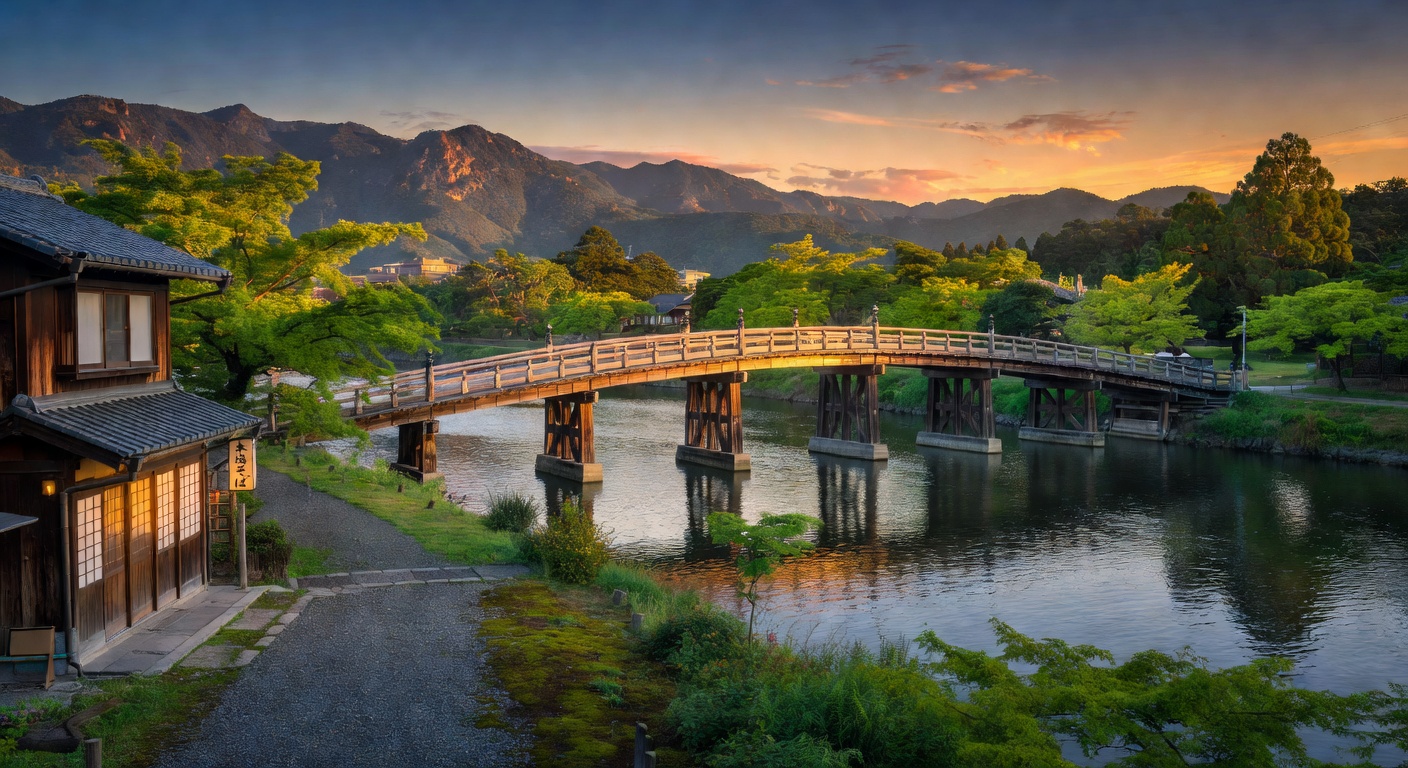
The annual number of users of the Senkoji Ropeway, 620,000, is a significant figure for the small town of Onomichi. However, this number has a unique structure. Many tourists visiting Onomichi are day-trippers who ride the ropeway, enjoy the view of the Setouchi Islands from the observation deck, explore the sloping streets with cats and ancient temples, and do a bit of shopping in the shopping district before heading home—often spending only 3 to 4 hours.
Looking at Onomichi City’s tourism statistics, the number of overnight guests often accounts for only about 10% of the total visitors. In other words, even if 620,000 people ride the ropeway, the majority are likely “non-staying guests.” The average spending of day-trippers is typically one-third to one-fourth that of overnight guests. With a round-trip fare of 700 yen for the ropeway, a lunch costing 1,000 yen, and 500 yen for souvenirs—each person leaves having spent around 2,000 to 3,000 yen.
Assuming 620,000 visitors each spending 2,500 yen, that amounts to about 1.5 billion yen. On the other hand, if just 10% of them stayed overnight and spent 15,000 yen each, that would yield about 930 million yen (62,000 x 15,000 yen). Just a 10% increase in overnight guests would generate an economic effect equivalent to 60% of the spending by day-trippers. Even though the numbers are the same, the financial impact left in the region is vastly different between “transit” and “stay.”
Onomichi boasts the Shimanami Kaido, an internationally recognized cycling route. Facilities like ONOMICHI U2, which combine accommodation and dining, have also emerged. The seeds for “reasons to stay” already exist. The question is whether these seeds are connected as part of the overall structure of the town. Using the 620,000 ropeway users as an “entrance,” showcasing the sunset over the Onomichi Strait, and guiding them through the morning shopping district—designing such experiences will create a pathway to transform transit into stay.
—
Overlapping the Three Numbers—The Presence or Absence of a ‘System’ as a Divergence Point
2.12 million, 2.58 million, 620,000. What becomes clear when we line up these three numbers is the distance between “people coming” and “people staying.”
Hiroshima City possesses the overwhelming attraction of the Atomic Bomb Museum, yet it lacks sufficient systems to extend the stay time beyond that. Onomichi, with its strong appeal for day-trippers, finds it difficult to transition to overnight stays. The figure of 2.12 million foreign overnight guests represents the total for the entire prefecture, but the benefits are geographically limited.
Each of these numbers appears to signify “success.” However, when we break down the contents of that success, we see regions standing on the boundary between “transit” and “stay.” The increase in tourists is good news in itself. However, if we cannot answer where these increased visitors spend their time, where they leave their money, and whose lives become a little easier as a result—then the numbers will remain just numbers.
Transforming “transit” into “stay” is not solely the effort of individual facilities. It requires a system that connects accommodation, dining, experiences, and transportation as a single flow—in other words, the editorial power of the entire region to design the visitors’ “next hour.” In Hiroshima City, this could mean connecting the museum to the riverside night view and then to Shukkeien the following morning. In Onomichi, it could involve linking the breathtaking views from the ropeway to the evening ferry and then to the bakery the next morning.
Numbers record the past. However, how we embed the “next hour” within those numbers is left to future design. 2.12 million stayed, 2.58 million visited, and 620,000 rode—can we create reasons for one more night, one more meal, or one more step beyond that? Hiroshima’s tourism currently stands on that boundary.


 JA
JA EN
EN