



Care Workers Confounded by Hiroshima Dialect, Indonesian National Exam Passer — Understanding the Mechanisms on Both Sides of the ‘Language Barrier’

Related Articles
The Same ‘Language Barrier’ Creates Confusion in Some Settings While Opening Doors for Others
Two contrasting stories have emerged from the caregiving scene in Hiroshima Prefecture. One reports that foreign care workers are struggling to communicate with users due to confusion over the Hiroshima dialect. The other shares the news of an Indonesian woman working at a care facility in Fuchu City who has passed the national examination for care workers.
On one side, there is confusion; on the other, achievement. Yet both stand before the same wall of “language” — the difference is not solely due to individual effort. What mechanisms were in place before reaching the wall? Without understanding this, the significance of these two news stories remains obscured.
Beyond the Effective Job Offer Ratio — Structural Labor Shortages Revealed by Numbers
According to the Ministry of Health, Labour and Welfare, the effective job offer ratio for caregiving positions in Hiroshima Prefecture has generally fluctuated between 3 and 4 times in recent years. Compared to the overall average of around 1.3 times across all occupations, the disparity is stark. Even when job offers are made, people do not come — this is not a temporary phenomenon but a structural issue compounded by an aging population and a declining working-age population.
The Ministry of Health, Labour and Welfare estimated in 2021 that approximately 320,000 caregiving personnel would be lacking nationwide by the fiscal year 2025. Hiroshima Prefecture is no exception, and the prefecture has actively promoted the acceptance of foreign caregiving personnel. Various residency status frameworks, including candidates based on the EPA (Economic Partnership Agreement), the Technical Intern Training Program, and Specified Skilled Worker status, have been established, attracting staff from countries primarily in Southeast Asia to care facilities in the prefecture.
However, while the system is designed to “deliver” people, what happens once they arrive is another matter altogether.
“Te-gou suru?” Does Not Register — The Invisible Wall of Dialect
Many foreign care workers have studied Japanese at a level between N4 and N3 of the Japanese Language Proficiency Test before coming to Japan. Basic conversations can be established if they use standard Japanese found in textbooks. However, the language spoken by users in caregiving settings is not textbook Japanese.
The Hiroshima dialect has unique vocabulary and inflection. For instance, “te-gou suru?” means “Can I help you?” but reports indicate that foreign staff have stood frozen, unable to understand what was being asked. The term “habuteru” means “to sulk” in Hiroshima dialect, and if this crucial word fails to convey the user’s emotional state, it can impact care decisions. Expressions like “taigii” (troublesome) and “inagena” (strange) are naturally used by users to communicate their physical condition or mood.
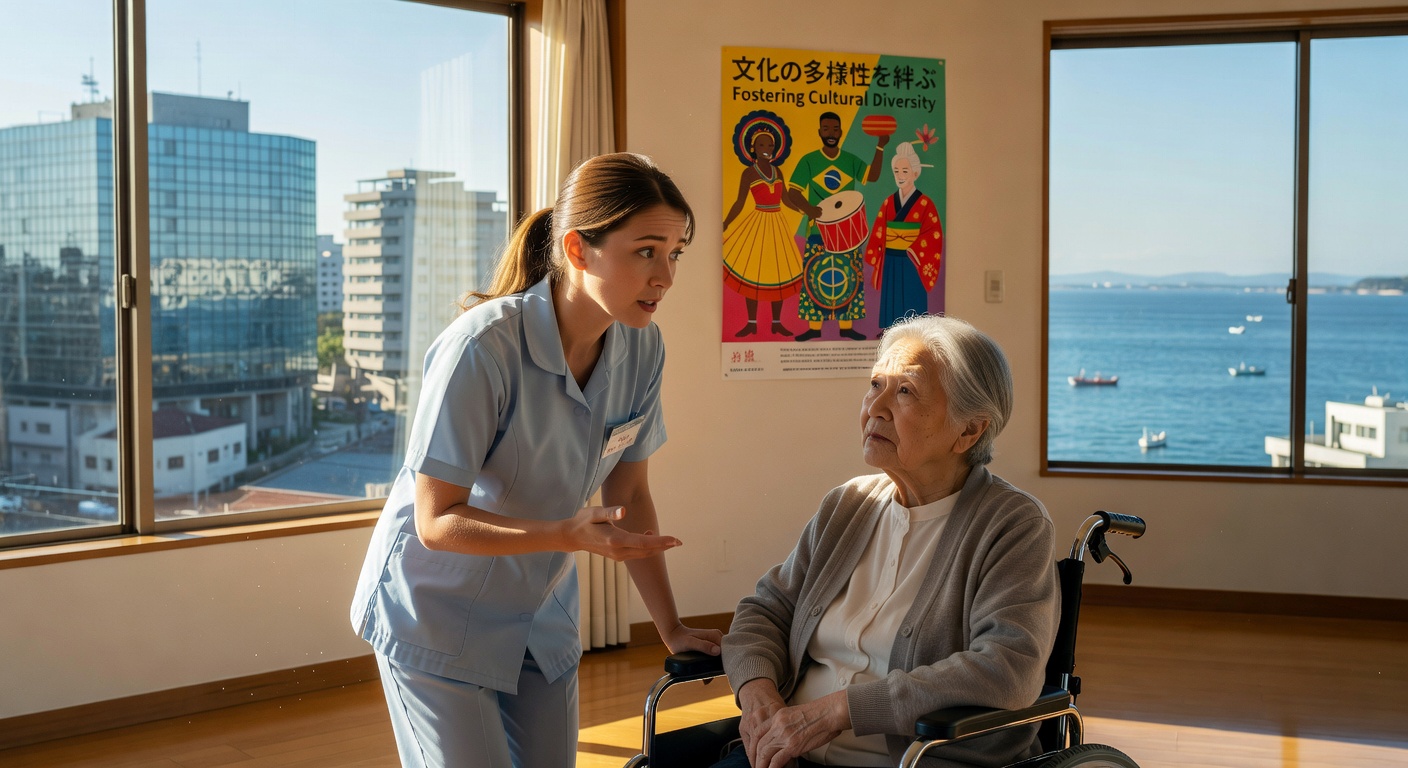
It is important to note that this is not merely a one-way issue of “foreigners lacking Japanese skills.” Dialects are the mother tongue and everyday language for users. It is unrealistic to ask elderly users to speak in standard Japanese, and doing so would undermine their dignity. Thus, the “language barrier” exists not only on the side of foreign staff but also on the side of users. The wall stands on both sides.
In response to this challenge, Hiroshima Prefecture has created a “Dialect Handbook” for foreign care workers. This handbook lists frequently used Hiroshima dialect terms alongside their standard Japanese translations, providing examples for various situations. In some facilities, Japanese staff take on the role of “interpreters,” conveying users’ dialect to foreign staff in simpler terms.
However, the handbook is merely an entry point. Dialects change meaning based on context, tone, and facial expressions. There are nuances that cannot be captured by translations on paper. A significant portion of the learning occurs gradually through daily conversations in the field. The real issue is whether the workplace can afford to wait for the “time to acclimate” — and whether a supportive structure is in place to allow for that.
The Path Walked by the Fuchu City Passer — A System that Supported Four Years
An Indonesian woman working at a care facility in Fuchu City has passed the national examination for care workers. She came to Japan under the EPA framework and has been assigned to the facility for about four years. She has been simultaneously learning Japanese and acquiring specialized knowledge in caregiving as she prepared for the exam.
Candidates for the EPA program are required to undergo approximately six months of Japanese language training before arriving in Japan. After arrival, the accepting facilities are obligated to provide learning support for candidates, including correspondence courses, mock exams, and learning materials through the Japan International Cooperation Center (JICWELS). There is also a system in place that subsidizes up to approximately 360,000 yen per year for learning support per candidate.
It is not incorrect to describe her success as the result of “individual effort.” However, one should not overlook the fact that there were rails laid down by the system and the facility that led to the fruition of that effort. Pre-arrival training, securing study time after placement, one-on-one guidance from Japanese staff, and materials for exam preparation — these mechanisms worked together to achieve the result of passing the exam four years later.
The pass rate for the national examination for care workers is around 70% for all candidates, including Japanese examinees, but in recent years, it has often remained in the 50% range for EPA candidates. The barrier of specialized terminology written in Japanese remains high. Nevertheless, the pass rate has steadily increased from just a few percent at the start of the program, which can be reasonably interpreted as a result of improvements in the support systems rather than individual qualities.
What Divided the Two Settings — The Design After ‘Delivery’
The setting where staff are confused by the Hiroshima dialect and the individual who passed the national exam reveal that while the system for “delivering” people is relatively well-established, there is still significant variability in the mechanisms that support daily life after they arrive — the placement.
In frameworks like that of EPA candidates, where a clear roadmap from arrival to exam success is designed, learning support can be systematically organized. In contrast, for staff who arrive under the Technical Intern Training Program or Specified Skilled Worker status, the level of Japanese language education and the availability of dialect support largely depend on the discretion and capacity of the accepting facility. Some municipalities distribute dialect handbooks, while others lack such support.
In other words, even among “foreign care workers,” the thickness of the support structures for language varies greatly depending on which residency status they come under, which facility they are assigned to, and which region they work in. The structure that relies on individual effort versus the one that supports through systems — this difference separates the confusion in the field from individual achievements.
Who Benefits from This?
The creation of dialect handbooks and the learning support for EPA candidates may initially appear to be initiatives aimed at “helping foreign staff.” However, taking a step back, it becomes clear that these mechanisms ultimately ease the burden on the users receiving care.
If staff can understand the users’ words, they can pick up on changes in health from a simple remark like “taigii.” If those around them notice “habuteru,” they can quickly attend to emotional care. Understanding each other is foundational for safety and dignity. This is a mechanism not just for foreign staff but also for the elderly who need their assistance.
The challenges faced by the caregiving scene in Hiroshima Prefecture are not unique to Hiroshima. The wall of dialect exists everywhere in the country. Tsugaru dialect in Aomori, Satsuma dialect in Kagoshima, and Uchinaaguchi in Okinawa — each region has its unique language, and the structure of foreign staff entering these environments will continue to expand.
A uniform approach to Japanese language education nationwide will not overcome this wall. Supporting local languages with local mechanisms will be essential for the future acceptance of foreign caregiving personnel.
Future Points of Interest
First, to what extent will Japanese language education, including dialect support, be standardized as a system by municipalities and industry organizations rather than being left to individual facilities? Second, how much will the quality and quantity of learning support be improved for residency statuses other than EPA — such as Specified Skilled Worker and Technical Intern Training Program? Third, how will understanding be promoted on the user side — how will information and psychological support for the elderly and their families interacting with foreign staff be designed?
The language barrier cannot be toppled by pushing from only one side. When the efforts of foreign staff to learn Japanese, the efforts of the accepting side to establish systems, and the time for users to accept new relationships all come together, the wall will gradually transform into a door.


 JA
JA EN
EN