


Kosen Students from Hakushima Unearth Hokkaido’s Pioneer History, a Director of a Film Shot in Onomichi Fears Local Eyes, and Nobuhiko Obayashi’s Daughter Walks the Filming Locations — The Intersection of ‘Outsider’s Eyes’ and ‘Local Eyes’ in Present-Day Onomichi

Related Articles
Kosen Students from Hakushima Unearth Memories of Migration Connecting Hiroshima and Hokkaido
Hakushima, a remote island off the coast of Onomichi City, has a population of less than 400. Here, students from Kamiyama Comprehensive Technical College are establishing a base and engaging in community-rooted inquiry-based learning. Surprisingly, their current focus is on the history of Hokkaido’s pioneers.
The catalyst was the name “Moseushi,” located in the Kitamura area of Iwamizawa City, Hokkaido. During the Meiji period, migrants from Hiroshima Prefecture settled in this area and built a community. The Kosen students, with the cooperation of local museums and municipalities, are deciphering migration registries and letters from that time, tracing the footsteps of those who traveled from Hiroshima’s port to Hokkaido.
Notably, this research does not close itself off as merely a “Hokkaido story.” There are few records remaining from the side of the migrants’ departure — that is, from Hiroshima and Onomichi. The demographic changes in the sending village, the lives of the families left behind, and the landscape of the port. The Kosen students are attempting to shed light on the historical gaps of the “remaining side” through the stories of those who “left.”
In a sense, the students studying on this remote island are themselves “outsiders.” The fresh perspectives of young individuals from outside the island are digging into the memories of those who left during the Meiji era — this nested structure gives the project a unique depth. Local historians have noted that “the research on migration history is heavily focused on Hokkaido, while the perspective of the sending area has been significantly underrepresented,” suggesting that the students’ investigation could be a step towards filling this gap in local history.
The research is still ongoing, but plans are in place for future exchanges with residents of Iwamizawa City and investigations of related materials remaining in Hiroshima Prefecture. The classroom on this remote island is gradually becoming a knot that connects the memories of two lands separated by the sea.
—
“The Opinions of Locals Are the Most Terrifying” — The Gaze Faced by a Film Shot in Onomichi
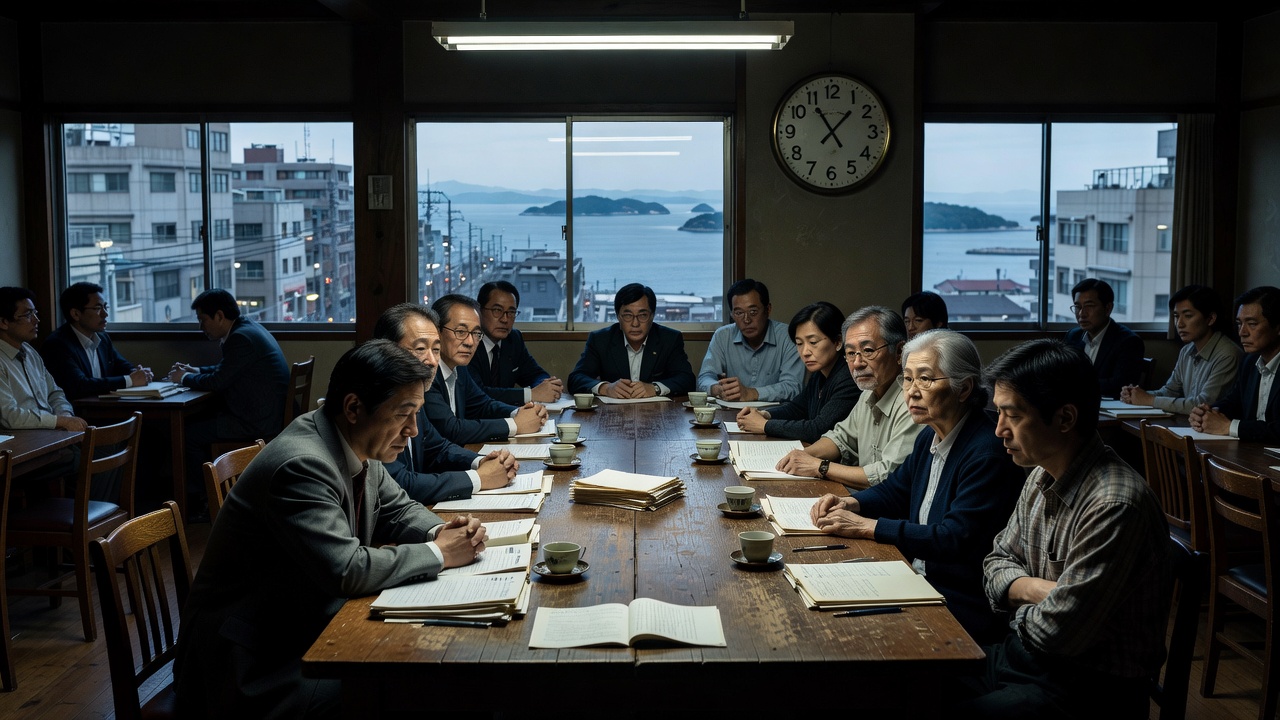
Onomichi is a city of films. The landscape of slopes, sea, and alleys has been captured by countless cameras over the years. However, being chosen as a filming location is not the same as being accepted by the locals.
Recently, a director of a film shot in Onomichi expressed, “The scariest part of the preview screening is the opinions of the locals.” Behind the scenes that tourists perceive as “a beautiful town,” local residents sense the nuances of their own lives. The way alleys curve, how laundry is hung, the intonation of dialects — even slight discrepancies can create an invisible chasm between the film and the town.
This tension is not limited to Onomichi. As the number of films and dramas shot in rural areas increases, there is always the underlying question of “Whose story is this for?” The economic benefits of attracting filming — accommodation, dining, and hiring extras — are appealing to municipalities. However, when the town depicted in the film diverges from the residents’ realities, the work becomes “a picture drawn by an outsider.”
Conversely, if the film aligns too closely with local perspectives, it may fail to resonate with external audiences. In this tug-of-war, the director chose the stance of “looking closely enough to be feared by the locals.” From the scouting phase, they engaged in dialogue with local residents and reflected that in the script. Even during filming, they would jot down casual remarks from passersby. How the completed film will be received locally is still uncertain. However, the very ability to say “scary” is proof that this director does not take the gaze of Onomichi lightly.
What a film leaves behind in a town is not just the visuals. Through the filming process, local people reassess their landscapes through “outsider’s eyes” — that experience itself gradually updates the town’s self-awareness.
—
Chigumi Obayashi Walks Through Onomichi, the Place of Her Father, Nobuhiko Obayashi
When discussing Onomichi and film, one cannot avoid mentioning director Nobuhiko Obayashi. “The Transfer Student” (1982), “The Girl Who Leapt Through Time” (1983), and “Lonely Hearts” (1985) — the so-called “Onomichi Trilogy” has etched this town into the memories of film fans nationwide. Even after the passing of Director Obayashi in 2020, visitors continue to seek out his works in Onomichi.
Chigumi Obayashi, the director’s daughter, walked the filming locations in Onomichi for a television program. What she shared in the program were not glamorous behind-the-scenes anecdotes, but rather mundane and specific memories. The rice balls that neighbors brought during filming. The sight of staff carrying equipment up the slopes. The time her father spent gazing at the sea at dusk.
Chigumi’s perspective oscillates between the internal position of being “the director’s daughter” and the external position of “reassessing the works objectively after her father’s death.” For her, Onomichi is both “the stage of her father’s films” and “the place where her father was,” and while these two aspects overlap, they are not the same.
Interestingly, the reactions from local residents vary. Some take pride in Obayashi’s films as “the films of their town,” while others feel that “the Onomichi depicted in the films is different from the Onomichi where we live.” Director Obayashi himself remarked in a late interview, “The Onomichi in the films is the Onomichi in my memory, and it differs from the real Onomichi.”
What emerges as Chigumi walks the filming locations is the richness of this very “discrepancy.” The Onomichi depicted in films, the Onomichi where locals live, the Onomichi remembered by the director, and the Onomichi that Chigumi walks today — multiple timelines overlap on the same slopes.
—
The Intersection of Three Stories
Kosen students from Hakushima, a film director, and the daughter of Nobuhiko Obayashi. What they all share is that they stand between the “outsider’s eyes” and the “local eyes.”
The Kosen students, while being “outsiders” from outside the island, are digging into the region’s history from their base on the island. The film director, although an external creator, is fearful of the local gaze and strives to respond to it. Chigumi, while being on the “inside” as the director’s family, reassesses the works and the town from an external perspective after her father’s death.
When these three movements are lined up, it becomes clear that the local story cannot be established by “one person’s answer.” The outsider’s eyes can only skim the surface. The local eyes, being too close, may miss what is visible. The story is updated in the moments when these two perspectives intersect, sometimes clash, and sometimes overlap.
The town of Onomichi is also a place where these intersections have repeatedly occurred. Meiji-era migrants left, film cameras entered, tourists walked, and new “outsiders” arrived. Each time, the town’s story is rewritten, overwritten, sometimes forgotten, and then rediscovered by someone.
Points of Future Interest
- Research by Kosen Students from Hakushima: If exchanges with residents of Iwamizawa City are realized, it will be a rare case of bidirectional historical research between the “sending area” and the “receiving area” on a national scale. We should pay attention to the timing and format of the presentation of results.
- Post-Release Reactions to the Film Shot in Onomichi: How will local residents’ reactions be articulated? In the age of social media, “local voices” have become more visible. What kind of dialogue will emerge between the evaluation of the work and the acceptance of the region?
- Inheritance of Obayashi’s Works: Through Chigumi’s activities, will Obayashi’s films continue to function not as “past legacies” but as “starting points for ongoing dialogue”?
Each of these three events is moving in its own context. However, they all revolve around the same question — Who will write the story of this land next? The answer is likely not a single name but exists within the very moments when perspectives intersect.


 JA
 EN