



40% Find Parenting Difficult, 1,000 Fewer Junior High School Applicants in 5 Years, 30,000 Copies of Ending Notes Reprinted—Hiroshima City’s ‘Entrances and Exits of Life’ Reflect Quiet Tectonic Shifts

Related Articles

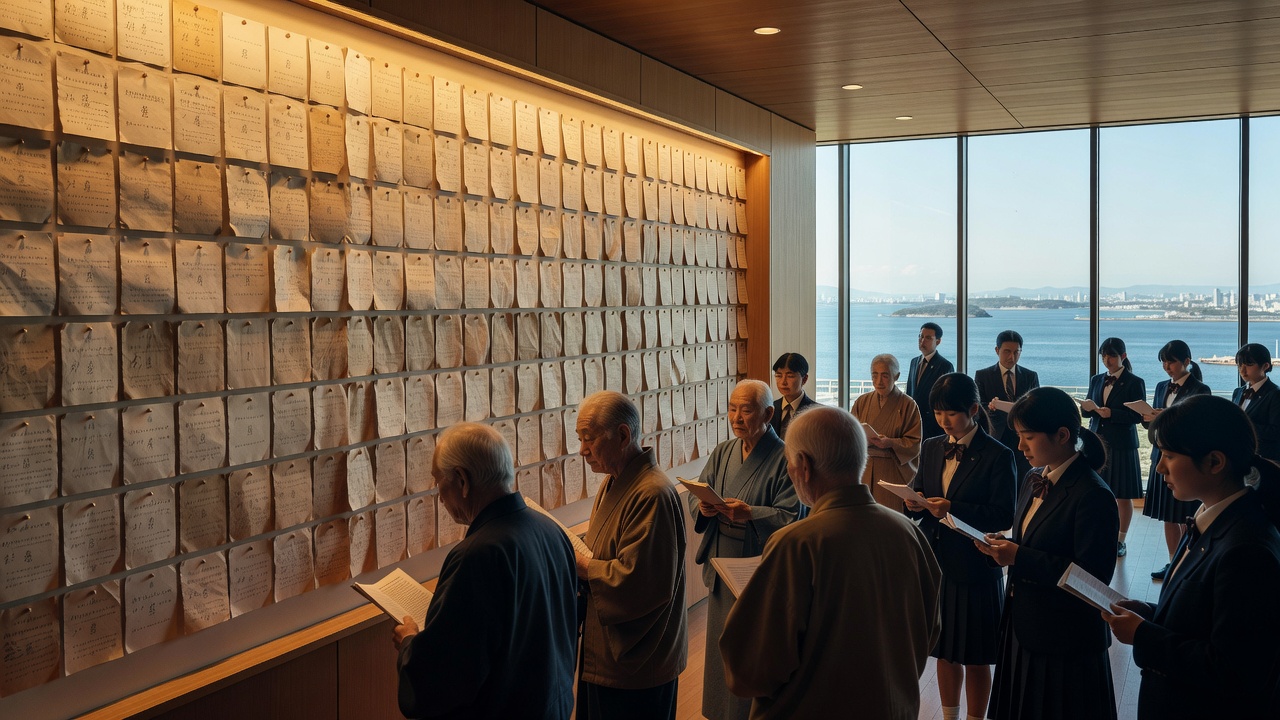
Same City, Narrowing Entrances and Organized Exits
In Hiroshima City, three numbers quietly align.
Approximately 40% of respondents in their 30s answered that they find parenting “difficult” in a satisfaction survey. Over the past five years, the number of junior high school applicants in western Hiroshima Prefecture has decreased by more than 1,000. And the city has decided to reprint 30,000 copies of its ending notes.
Each of these figures may seem like a “common topic for regional cities” when viewed in isolation. However, when placed together, a single structure emerges. In the realm of parenting and education, which represents the entrance to life, a gap is widening between systems and personal experiences, while in the realm of end-of-life planning, which represents the exit, citizens are actively utilizing the available frameworks. Within the same municipality, the entrance is narrowing while the exit is being organized. This temperature difference is the outline of the changes occurring in Hiroshima City’s population structure.
—
40% Find Parenting “Difficult”—What the Parenting Satisfaction Survey Reveals
In a satisfaction survey conducted by Hiroshima City regarding parenting, about 40% of respondents in their 30s expressed that they find parenting “difficult.” Notably, this figure is encapsulated not as “dissatisfaction” but as “difficult.” While dissatisfaction implies anger towards systems or treatment, “difficult” suggests a sense of something not quite fitting within the daily flow of life.
Several factors are cited as contributing to this perception, including long working hours, the convenience of childcare services, and the weakening of local communities. However, these issues are not unique to Hiroshima City; many designated cities across the country face similar challenges. The concern lies in the possibility that Hiroshima City is becoming one of those places that are “not chosen” among them.
Looking at Hiroshima City’s demographic trends, there has been a continued outflow of residents since 2020, particularly among those in their late 20s to 30s—the very generation standing at the entrance of parenting—who are moving to the Tokyo area or nearby Fukuoka City. The responses indicating “difficult” reflect the voices of those already in the city. The number of people who left without voicing their concerns is not captured in this survey.
In response to these results, Hiroshima City has established the “Children, Youth, and Parenting Policy Promotion Headquarters.” Mayor Kazumi Matsui has stated that he will approach this issue with a sense of urgency. While the establishment of the headquarters is a step forward, what is truly at stake is not “what to change” but “whose voices to prioritize.” The 40% figure from the survey can serve as a starting point for policy, but it should not be the endpoint.
—
1,000 Fewer Junior High School Applicants in 5 Years—The “Ebb Tide” of Educational Investment
Another piece of data illustrates the cooling temperature of parenting from a different angle. The number of junior high school applicants in western Hiroshima Prefecture has decreased by more than 1,000 over the past five years.
How should we interpret this figure? The decline in the number of children due to low birth rates is certainly a factor. However, a decrease of 1,000 cannot be solely explained by a simple drop in birth rates. The junior high school entrance exam is an act where families concentrate their time, money, and effort on education. Tuition alone can range from 500,000 to 1,000,000 yen annually, and in some cases, even more. The decrease in applicants suggests not only that there are fewer children but also that there may be an increasing number of families with less motivation or capacity to invest at that level.
On the other hand, the diversification of entrance exams—such as the rise of integrated public junior high and high schools, the proliferation of online education, and a reevaluation of local public schools—has also expanded options. In other words, “not taking the exam” does not necessarily mean “giving up on education.” However, for local private junior high schools, the decrease in applicants is fundamentally related to their management. From the perspective of the sustainability of educational institutions, this is part of the chain reaction caused by the narrowing of the entrance.
—
30,000 Copies of Ending Notes Reprinted—The Exit Mechanism is Being “Utilized”
While the entrance is narrowing, a different movement is occurring on the exit side.
The ending notes published by Hiroshima City have been well received, leading to a decision to reprint 30,000 copies. Ending notes are tools for recording wishes regarding medical care, nursing, asset organization, and funeral plans at the final stages of life. While they do not have legal binding power, they are said to facilitate consensus among family members and help realize care that respects the individual’s wishes.
The figure of 30,000 is an unusual scale for administrative distribution. As of 2023, Hiroshima City’s population aged 65 and over is approximately 330,000. Simple calculations suggest that about one in ten elderly individuals has taken hold of a copy. Moreover, it is significant that this increase in copies is a result of demand rather than mere distribution.
What is visible here is the fact that the end-of-life planning generation is not passively waiting for the system but actively mastering the available frameworks. The ending notes will not spread simply because the administration “provided” them. The act of writing involves the burden of reflecting on one’s life and articulating considerations for those left behind. Nevertheless, the demand for 30,000 copies indicates that this generation possesses the intention to “design their own exit.”
—
What the “Temperature Difference” Between Entrances and Exits Means
Let’s rearrange the three numbers:
- 40% of the parenting generation feels that parenting is “difficult.”
- The number of families choosing to concentrate their educational investment (junior high school entrance exams) has decreased by 1,000 in five years.
- 30,000 copies of a notebook for organizing life’s exit have been sought by citizens.
This structure reflects the differences in the “distance to the system” between generations. The parenting generation feels that even with systems in place, they are not reaching them in a tangible way. In contrast, the end-of-life planning generation actively seeks out and utilizes the systems. Within the same municipality, the trust in and utilization of administrative services varies significantly.
Why does this gap exist? One hypothesis is that for the end-of-life planning generation, the ending notes serve as a tool that concludes as “personal matters,” whereas parenting support requires multiple systems—workplace, childcare, healthcare, and community—to function together. An ending note can encapsulate one’s wishes in a single book, while parenting support cannot be resolved through just one point of contact.
Whether Hiroshima City’s “Children, Youth, and Parenting Policy Promotion Headquarters” truly functions will depend on its ability to confront the complexity of this structure head-on. What the parenting generation likely seeks is not a “new system” but rather that “existing systems align within their daily life flow.”
—
Whose Convenience Does the System Serve?
Changes in population structure may appear gradual when viewed as a curve on a graph. However, within that curve lie the ten minutes of a morning spent running after dropping off a child, the conversations at night deciding to forgo entrance exams, and the afternoons spent writing in a notebook, “I do not wish for life-prolonging treatment.”
Numbers reveal structures. Yet within those structures, there are always individual decisions.
What Hiroshima City will be asked moving forward is not whether to allocate budgets to the entrance or the exit. It is whether those standing at the entrance can be put in a position to trust and utilize the system just as much as those organizing the exit.
The 30,000 copies of ending notes have proven that systems will be utilized if they reach people. The 40% of the parenting generation expressing that parenting is “difficult” is a quiet yet urgent report that the system has not yet reached them.
A system that reaches people can be created. The demand for 30,000 copies has already proven that.


 JA
JA EN
EN