



Abandonment of the Flying Boat Museum, Third Year of the Sake Project, and a Meat Specialist as Tourism Ambassador—How Will Iwakuni Become a City That Sustains Itself?

Related Articles
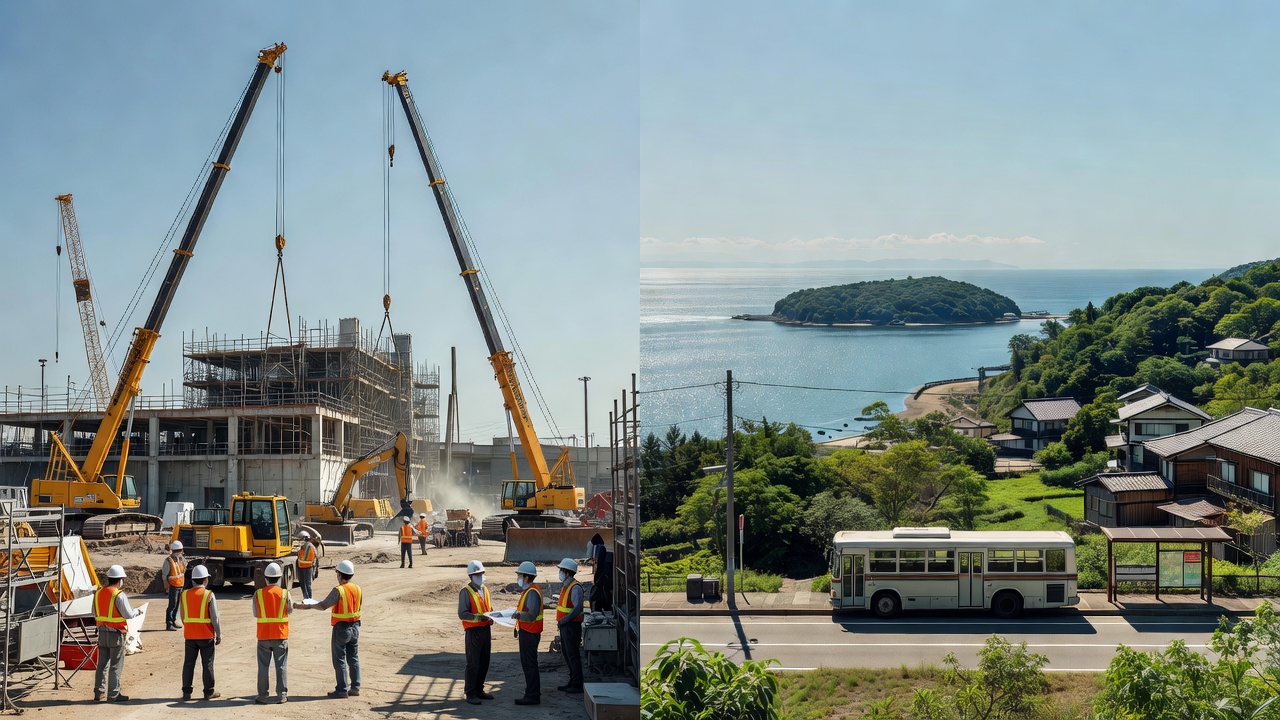
Abandonment of the Flying Boat Museum—What the “Failure to Build” Tells Us
The disappearance of a 3 billion yen “box” has left behind sake, meat, and enka—this may sound like a joke. However, when we lay out what is currently happening in Iwakuni City, a quiet and urgent process emerges in which a local city is re-evaluating what it wants to showcase. The abandonment of the flying boat museum project, the entry into the third year of the sake regional revitalization project involving Atsushi Tamura, and the appointment of a meat specialist and an enka singer residing in London as tourism ambassadors. When we read these three movements together, we can see the outline of a city attempting to shift from “structures to people.”
—
The Flying Boat Museum—What the “Failure to Build” Reveals
The flying boat museum envisioned by Iwakuni City was planned as a facility to convey the history and technology of the aviation industry, centered around the display of the US-2 rescue flying boat manufactured by ShinMaywa Industries. After repeated discussions with the Ministry of Defense and related agencies, the conclusion was reached that support from the national government would be difficult, leading the city to announce the abandonment of the construction.
The initial estimated maintenance cost of about 3 billion yen was expected to increase further due to rising material costs and a review of the exhibition design. Additionally, the estimated annual maintenance costs, securing curators, and maintaining exhibits weighed heavily on the city. It was financially unrealistic for the city to undertake the maintenance alone, and the prospects for attracting visitors were unclear—essentially, there was no clear answer to the question of “who will support it after it is built?”
To dismiss this abandonment as a mere “failure” is somewhat misleading. Rather, what deserves attention is what remains and what continues to move after the plan has faltered. In the place where a large facility was not built, other initiatives have already begun to sprout. It is in this contrast that the current state of Iwakuni is reflected.
—
Sake Regional Revitalization Project—The Mechanism Behind the “200 Million Yen in Sales”
The sake regional revitalization project involving talent Atsushi Tamura from Iwakuni City has entered its third year. This initiative, in collaboration with local sake breweries, aims to deliver Iwakuni’s sake nationwide and has reportedly achieved sales of approximately 200 million yen in the previous fiscal year.
Looking at the numbers alone, one might interpret it as “selling due to the celebrity’s fame.” However, a closer examination of the structure of this project reveals a different perspective.
Iwakuni has several sake breweries blessed with the underground water of the Nishiki River, providing a foundation for sake production. The project functions as a mechanism to jointly develop sales channels that individual breweries cannot reach alone—such as urban restaurants, online sales, and tasting events. Tamura’s role is both as a “face” and as a hub for external connections. This allows the brewers to focus on brewing while supporting communication and distribution at a different layer. It is not just individual effort, but a system that operates through complementary roles.
Tamura himself has stated, “I want to convey the charm of Iwakuni through sake.” While this can be taken at face value as tourism PR, the reality is somewhat deeper. Issues such as the succession problem of sake brewers, procurement of raw rice, and aging brewing equipment are structural challenges faced by local sake breweries that cannot be resolved by a single year’s campaign. The fact that it has entered its third year indicates that this project is designed with continuity in mind, rather than being a one-time topic.
To what extent do the 200 million yen in sales support the participating breweries’ management? What is the profit distribution mechanism? Detailed information on these aspects has not yet been sufficiently disclosed, but at the very least, the fact that “products bearing the name of the region are being sold at prices in external markets” carries more weight than a single line in a tourism brochure.
—
Tourism Ambassadors—The Placement of a “Meat Specialist” and a “London Enka Singer”
Iwakuni City has newly appointed two tourism ambassadors. One is a meat specialist responsible for promoting local meat culture and specialties, while the other is an enka singer residing in London, tasked with attracting overseas tourists and cultural exchange.
Upon seeing this selection, my first thought was that it was a “different angle.” A meat expert and a singer based overseas—at first glance, there seems to be no connection. However, when we overlap their roles, it becomes clear that Iwakuni City is attempting to open up along two axes: “food” and “overseas.”
While Iwakuni has well-known food cultures such as Iwakuni lotus root and Iwakuni sushi, the image of being a “meat city” is still weak. The appointment of a meat specialist seems to be an attempt to add a new perspective rather than just strengthening existing food brands. The extent to which collaboration with local livestock producers and restaurants materializes will determine the significance of this selection.
The appointment of the enka singer can be seen as a strategic move aimed at inbound demand. With a U.S. military base in Iwakuni, there are daily connections with English-speaking countries. As the number of foreign tourists visiting the Kintai Bridge is on the rise, placing a “conveyor of Japanese culture” in London is a design that allows someone to speak about Iwakuni from afar.
The system of tourism ambassadors exists everywhere in the country. However, the choice of “who to select” reflects the intentions of that municipality. The placement of these two individuals reveals a current answer to the question of “what to deliver from Iwakuni and to whom.”
—
From Structures to People—But a System That Doesn’t Rely Too Much on Individuals is Needed
When we juxtapose the abandonment of the flying boat museum with the movements of the sake project and tourism ambassadors, we can see a shift from “structures to people.” Instead of investing tens of billions of yen in buildings, multiple small initiatives centered around people are being launched. The costs are significantly lower, and it is easier to adjust direction.
However, there is a certain precariousness here. Projects centered around people will stop if those individuals are no longer present. What will happen to the sake project if Tamura withdraws? After the term of the tourism ambassador ends, what will remain?
Simply shifting from “dependence on structures” to “dependence on people” does not change the underlying structure. The question is whether the enthusiasm of individuals can be transformed into a system. In the case of the sake project, can it transition from relying on Tamura’s individual communication power to a stage where the network and sales channels among brewers can operate independently? In the case of the tourism ambassador, will individual activities end as one-off PR, or will they leave concrete connections in the local food and tourism industries?
This transformation from “people to systems” is the true turning point in the tourism strategies of local cities.
—
How Will Iwakuni Become a City That Sustains Itself?
Kintai Bridge, U.S. military base, aviation industry, sake, lotus root—there are multiple “faces” of Iwakuni. However, there is still no single signboard that clearly states, “This is what this city is known for.” The flying boat museum could have been that signboard, but it did not come to fruition.
Instead, multiple small pillars are currently in motion, focusing on sake, food, and overseas outreach. Rather than a single thick pillar, it is a structure supported by many thin pillars—though it may seem fragile, it possesses the strength that even if one breaks, the whole does not collapse.
Iwakuni has yet to provide a clear answer to the question of “what will sustain this city?” However, the very act of not narrowing down to a single answer may be Iwakuni’s current strategy. Rather than building a large structure, the aim is to create multiple connections between people and the land, waiting for one of them to take root.
It is a modest strategy. There are no glamorous groundbreaking ceremonies or ribbon-cuttings. However, within the activities of selling 200 million yen worth of sake, appointing a meat specialist, and delivering enka from London, there is a palpable sense that this city is searching for its next signboard.
The 3 billion yen museum was not built. Yet, the hands of those trying to fill that void are already in motion.


 JA
JA EN
EN