



Wooden Reconstruction of Hiroshima Castle and Groundbreaking of New Museum — Reading the Timeline of a City that ‘Rebuilds’

Related Articles
Wooden Reconstruction of Hiroshima Castle and Groundbreaking of New Museum — Reading the Timeline of a City that ‘Rebuilds’
The city of Hiroshima has a unique tension in its handling of time. Since August 6, 1945, nearly all of the buildings in this city have been categorized as being from “after that day.” The Hiroshima Castle keep, rebuilt in concrete after the war, and the former Army Clothing Depot, which still bears the scars of the atomic bombing, coexist in the same city, showcasing both “buildings that encapsulate memory” and “buildings that overwrite memory.”
Now, both of these aspects are in motion. The final report of the committee examining the wooden reconstruction of the Hiroshima Castle keep has been compiled, and construction of the new museum has begun, aiming for a spring opening in 2029. The former Army Clothing Depot is moving towards general public access, while the new Central Library has opened in front of JR Hiroshima Station. These are not isolated redevelopment projects; they are connected by a design philosophy unique to a city that has experienced bombing: “rebuilding while preserving memory.”
The Choice of Wooden Reconstruction — Why Not Concrete?
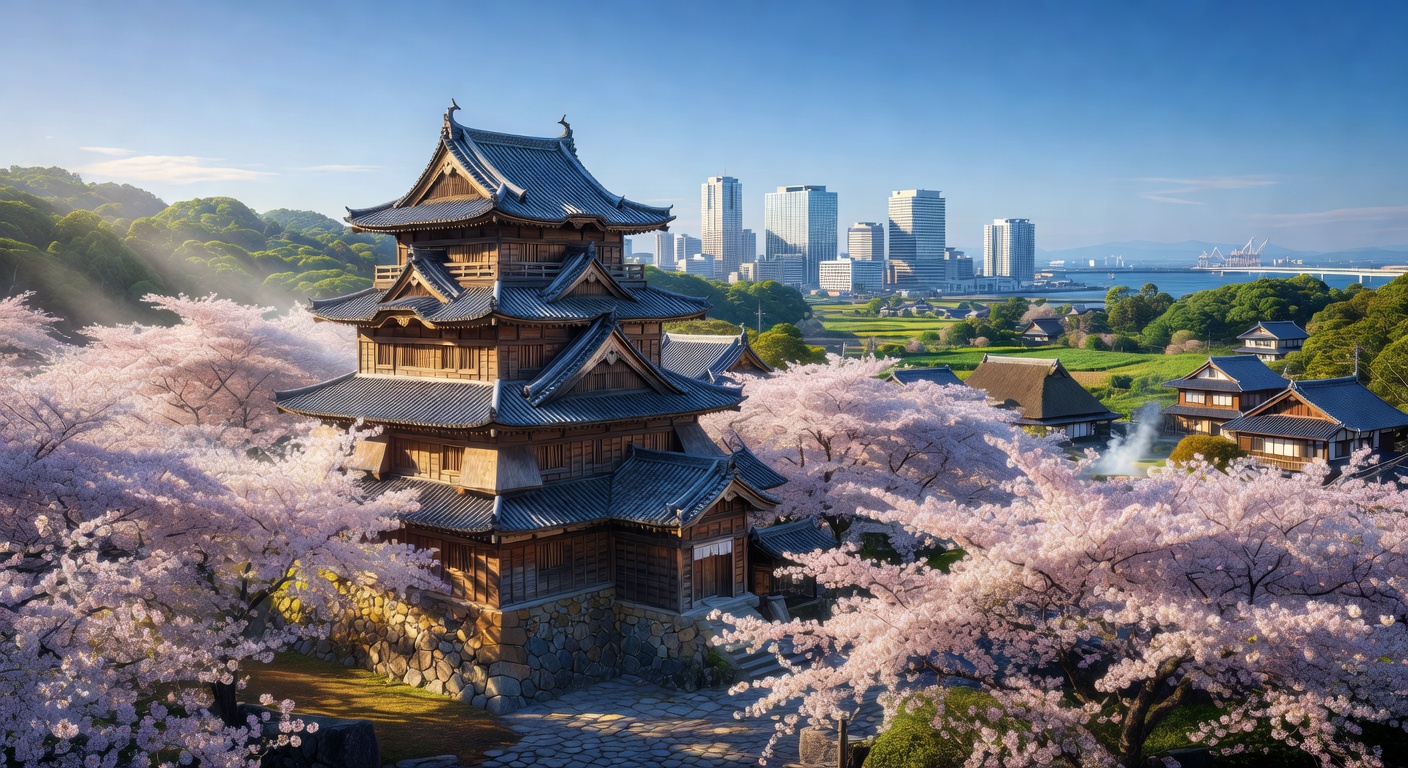
The keep of Hiroshima Castle was rebuilt in reinforced concrete in 1958, thirteen years after the bombing. At that time, the priority was to “restore the original appearance at all costs.” While the exterior mimics the Edo period keep, the interior serves as a museum, and the structure is essentially a concrete box.
Now, this concrete structure, which has reached 67 years of age, is deteriorating. There are also concerns regarding its earthquake resistance. The committee established by Hiroshima City has proposed “wooden reconstruction” for the rebuilding. The estimated project cost is around 7 billion yen.
Why choose wood? Rebuilding in concrete might be more cost-effective and quicker. However, the choice of wood stems from the desire to “connect with the time before 1945.”
Hiroshima Castle was built in 1589 by Mōri Terumoto. It functioned as the residence of the Asano clan throughout the Edo period and was used as an army facility after the Meiji period. It collapsed due to the atomic bomb in 1945. The current concrete keep embodies only the layer of “post-war reconstruction” from that history. The wooden reconstruction aims to physically reclaim the layer of time before the bombing — a span of 356 years from its construction.
Of course, there are challenges. Wooden reconstruction requires advanced traditional building techniques, and securing skilled artisans has become increasingly difficult nationwide. The significant delays in the wooden reconstruction plan for Nagoya Castle, originally scheduled for completion in 2022, highlight the difficulties of such projects. Additionally, how the citizens perceive the 7 billion yen project cost will be questioned. Hiroshima City’s general budget is approximately 700 billion yen, making discussions about prioritization with other public works unavoidable.
Still, this choice carries meaning. Recreating “the time before destruction” with wood and earth does not erase the memory of destruction; rather, it demonstrates that there was once a rich time before the devastation.
New Museum — Enriching the Cultural Layers of the City Towards 2029
The construction of the new museum in downtown Hiroshima represents another project with its own timeline. Scheduled to open in the spring of 2029, it plans to feature an outdoor Japanese garden and café.
The Hiroshima City Museum of Contemporary Art is located on Hijiyama and has served as a hub for contemporary art since its opening in 1989. However, its location on Hijiyama has made access from the city center challenging, resulting in stagnant visitor numbers. By placing the new museum in the city center, it integrates into daily movement patterns. It can be visited on the way to work or while shopping — this “incidental” design significantly influences the utilization rate of cultural facilities.
Notably, this museum is not just a plan for a “box.” The outdoor Japanese garden and café will create a space open to those who may not have an interest in art. Lowering the threshold for entering the museum and providing multiple “entrances” is crucial for the sustainability of cultural facilities.
Hiroshima already has several museums, including the Hiroshima Museum of Art, the Hiroshima Prefectural Museum of Art, and the Hiroshima City Museum of Contemporary Art. The opening of the new museum raises questions about how these facilities will share roles — or compete with each other. Ideally, each institution will cultivate different layers of audiences, enhancing the overall cultural richness of the city.
The Decision to “Open” Atomic Bomb Buildings
If the projects of Hiroshima Castle and the new museum are about “creating,” the consideration for the general public access to the former Army Clothing Depot is about “preserving.”
The former Army Clothing Depot, built in 1913, is a large complex of red brick warehouses and is one of the largest atomic bomb buildings still standing. Located about 2.7 kilometers from the epicenter, it still bears traces of the bombing — bricks discolored by heat and iron doors warped by blast waves. For many years, limited public access was due to concerns over deterioration and preservation costs, but Hiroshima Prefecture is now considering expanding access.
The significance of “opening” this building is profound. While the Atomic Bomb Museum serves as a place to convey memory through exhibits, the Clothing Depot itself is a place where the building embodies memory. The warped iron and burned bricks speak without words. In an era where 2.58 million people visit the museum, the opening of another “memory device” means diversifying the channels of Hiroshima’s narrative.
The Station Front Library and Design Award — “Rebuilding” in Everyday Life
Amidst large-scale projects, smaller “rebuilding” efforts are also underway.
The new Central Library, relocated in front of JR Hiroshima Station, has enhanced its floors for children and youth. Having a library at the station means that cultural facilities are integrated into the flow of people, even without the specific purpose of “borrowing books.” This aligns with the same philosophy of “incidental” design seen in the new museum.
Additionally, the community space “Yamayama Mita,” developed by Chudenko, has won the prestigious iF Design Award, one of the three major design awards in the world. The international recognition of a public space designed by a local company is evidence of Hiroshima’s “creative power” being acknowledged in the fields of architecture and design.
When we look at these movements together, a common theme emerges. They all embody the attitude of “rebuilding based on the previous time” rather than simply “demolishing and constructing anew.” Hiroshima Castle connects with the time before the bombing, the Clothing Depot preserves the time of the bombing, and the new museum and library update the post-war time. Projects with different timelines are progressing simultaneously within the same city.
The Timeline of a City that “Rebuilds”
For most cities, redevelopment means “demolishing the old and building the new.” Economic rationality demands this. However, Hiroshima cannot apply that equation directly. The memories of destruction are the very essence of this city’s identity.
The decision to invest 7 billion yen in wooden reconstruction and the decision to maintain and open the atomic bomb buildings cannot be explained solely by economic rationality. What lies beneath is the city’s will to “not treat time carelessly.”
The completion of the wooden reconstruction of Hiroshima Castle is still some time away. The new museum will open in 2029. The extent of public access to the Clothing Depot will depend on future discussions. None of these projects will materialize immediately.
However, the very act of not rushing may be the design philosophy of this city. The work of rebuilding while preserving memory takes time. A city that has chosen to take that time is quietly moving forward.


 JA
JA EN
EN