



The Remnant Flame of Hiroshima Lights Up in Hawaii as the NPT Conference Approaches—80 Years of the Mechanism for Carrying the ‘Fire’

Related Articles
The Remnant Flame of Hiroshima Lights Up in Hawaii as the NPT Conference Approaches—80 Years of the Mechanism for Carrying the ‘Fire’
A single flame has crossed the ocean.
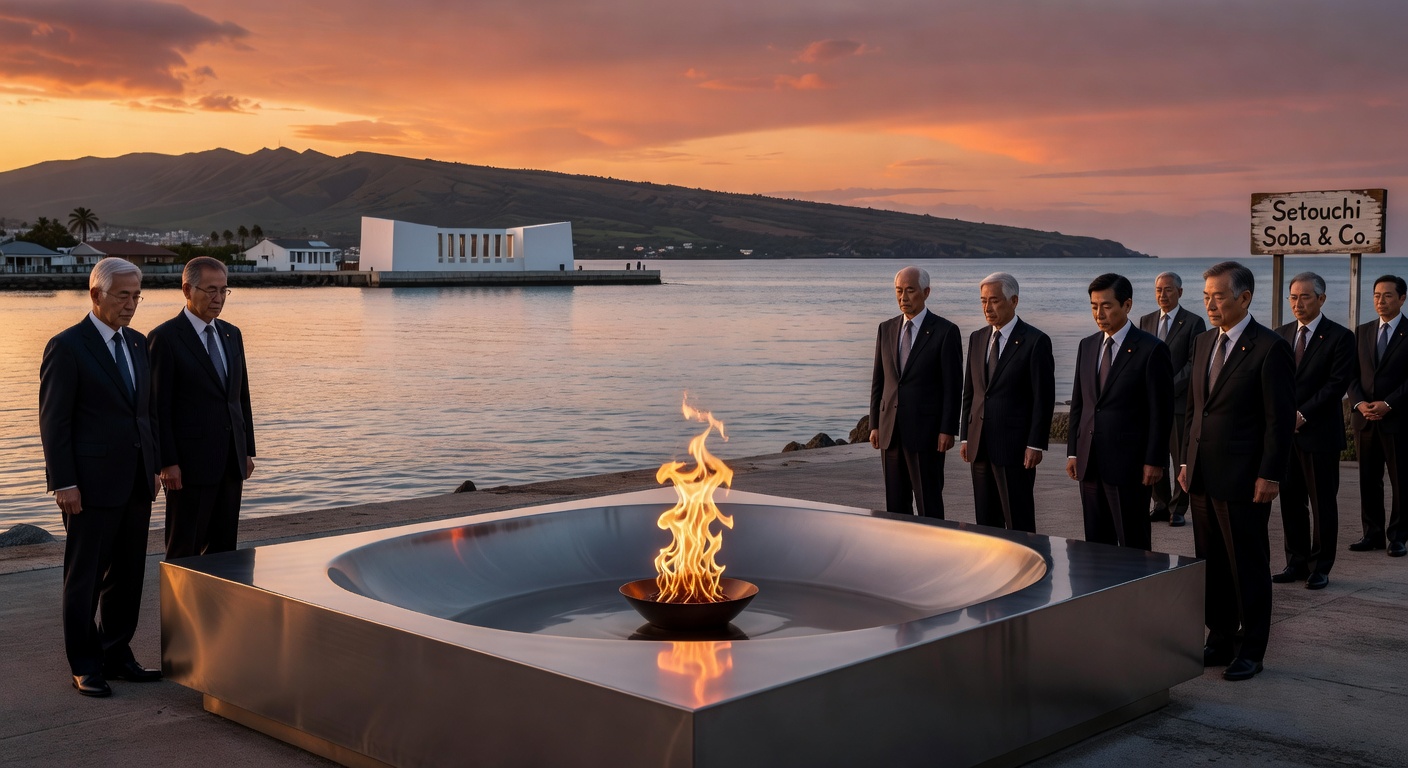
In May 2025, the remnant flame of the Hiroshima atomic bomb was lit during a ceremony at Pearl Harbor in Hawaii. Hiroshima Mayor Kazumi Matsui and Nagasaki Mayor Mitsuhiro Suzuki visited the U.S. Embassy to request observer participation in the Treaty on the Prohibition of Nuclear Weapons (TPNW) conference. Around the same time, it was revealed that the Austrian Ambassador to Japan is considering a partnership with Hiroshima Prefecture. Furthermore, Mayor Matsui has also made requests for nuclear disarmament to the Russian Ambassador to Japan.
When read as individual news items, these may seem like ceremonial diplomatic events. However, when viewed together, a different outline emerges—the very structure of the “circuit of requests” that the bombed cities have laid out over the past 80 years, that is, the arrangement of who to deliver requests to, in what order, and what to deliver.
What is the ‘Remnant Flame’?—The Diplomatic Function of Physical Fire
The remnant flame of the Hiroshima atomic bomb has been preserved in Yame City, Fukuoka Prefecture, since shortly after the bombing on August 6, 1945. This flame, known as the “Flame of Peace,” has been shared with various locations and lit at peace ceremonies both domestically and internationally. The flame itself has no legal binding power and lacks the ability to change policies. However, when people gather at the site where the flame is lit, words are exchanged, and requests are handed over. The flame has functioned as a “device for creating a space.”
The significance of this flame being lit at Pearl Harbor is not small. Pearl Harbor is where the memories of war between Japan and the United States intersect most sharply. When the flame from Hiroshima is lit at a site where the memories of perpetration and victimization overlap, it becomes an act of placing both sides’ pain in the same space, neither forgiveness nor oblivion. One can only imagine how much thought the designers of the ceremony put into that arrangement—considering the depth of the behind-the-scenes planning.
The Circuit of Requests—The Order of Delivery Established Over 80 Years
Looking back at the diplomacy of the bombed cities reveals a clear structure. The mayors of Hiroshima and Nagasaki have gradually expanded the range of those they appeal to for nuclear disarmament.
In the 1980s, Hiroshima City primarily appealed to domestic public opinion through its “Peace Declaration.” In the 1990s, the Mayors for Peace (formerly the Peace Mayor Conference) was established, forming a network that involved mayors from cities around the world. The number of member cities has now surpassed 8,400 across 166 countries and regions. In the 2010s, testimonies from atomic bomb survivors began to be directly shared at the United Nations during the negotiation process for the TPNW, leading to the treaty’s adoption in 2017.
And now in 2025. The simultaneous actions of Mayor Matsui and Mayor Suzuki have led to the U.S. Embassy, the Prime Minister’s Office, the Austrian Ambassador, and the Russian Ambassador—approaching four different positions: nuclear-armed states, the government of their own country which has not signed the treaty, countries promoting nuclear disarmament, and nuclear powers. This is not merely a repetition of “requests.” It is a multi-layered diplomatic design made possible by the trust and circuit accumulated over 80 years.
At the request meeting, Mayor Matsui stated, “Nuclear weapons are a threat to humanity, and we must not forget the lessons of our past.” This phrase has undoubtedly been repeated dozens or hundreds of times. However, the act of repetition itself is also a means of maintaining the circuit. By changing the recipients of the words while repeating the same message, the essence of the bombed cities’ diplomacy lies in this mechanism of sustainability.
The Significance of the Partnership with Austria—The Role of ‘Middle Powers’
The movement of the Austrian Ambassador to Japan considering a partnership with Hiroshima Prefecture may seem understated at first glance. However, understanding the role Austria has played in international politics regarding nuclear disarmament changes the weight of this partnership.
Austria hosted the “International Conference on the Humanitarian Impact of Nuclear Weapons” in Vienna in 2014, which was pivotal in initiating the negotiations for the TPNW. The first conference of the treaty’s signatories (2022) was also held in Vienna. As a “middle power” that is neither a nuclear-armed state nor a participant in NATO’s nuclear sharing, Austria can serve as a bridge.
Hiroshima’s connection with Austria signifies a shift in the bombed cities’ appeal from “an expression of emotion” to “a partnership in diplomatic strategy.” As we look ahead to the NPT (Treaty on the Non-Proliferation of Nuclear Weapons) Review Conference scheduled for 2026, it will be crucial to observe how this collaboration translates into concrete actions—one of the circuits to watch.
The Request to Russia—The Meaning of Delivering Even If It Doesn’t Reach
Regarding Mayor Matsui’s request for nuclear disarmament to the Russian Ambassador to Japan, some may say, “It won’t reach them.” Since the invasion of Ukraine, Russia has repeatedly made statements hinting at the use of nuclear weapons, and dialogue on nuclear disarmament has effectively stalled.
However, the requests from the bombed cities should not be measured solely by whether the recipient responds. The very fact that a request was made becomes a record for the international community. Requests that did not reach their destination also accumulate as part of the circuit. Ten or twenty years from now, if the international situation changes, the fact that “Hiroshima did not stop making requests back then” could become a key to reopening the circuit.
Diplomacy is not a transaction that yields immediate results. It involves laying the groundwork, maintaining the circuit, and keeping the state where words can reach when the time comes—this is precisely the work that the bombed cities have been doing for 80 years.
Towards the NPT Review Conference—The Structure Illuminated by the Fire
As the 2026 NPT Review Conference approaches, the international environment surrounding nuclear disarmament is becoming increasingly severe. The U.S.-Russia New START treaty is at risk of expiration, and reports of China’s nuclear force expansion are emerging. The divide between nuclear-armed and non-nuclear states continues to deepen.
In this context, what role can the bombed cities play? They hold no policy-making authority. They possess no military power. However, they have maintained an uninterrupted “circuit of requests” for 80 years. Lighting the fire, delivering words, and leaving records—the accumulation of this steady groundwork is the bombed cities’ response to the enormous challenge of nuclear disarmament.
The fire lit in Hawaii will eventually extinguish. However, the circuit that carried the fire remains. Who will maintain that circuit, and how—this question of the 80 years since the bombing is directed not at the past, but towards the arrangements for the future.


 JA
JA EN
EN