



53-ton Pedestrian Bridge, 500 Drones, 36-meter Beam—The Reasons Behind the Rise of ‘Large Movements at Night’ in Hiroshima

Related Articles
The City Moves After It Falls Asleep
1 AM. National Route 31 in front of Kure Station was closed to traffic. A 250-ton crane slowly lifted a 53-ton pedestrian bridge. The voices of the workers were subdued, and only radio communications quietly exchanged—about four hours later, a bridge that hadn’t existed the day before stood in front of the station as dawn broke.
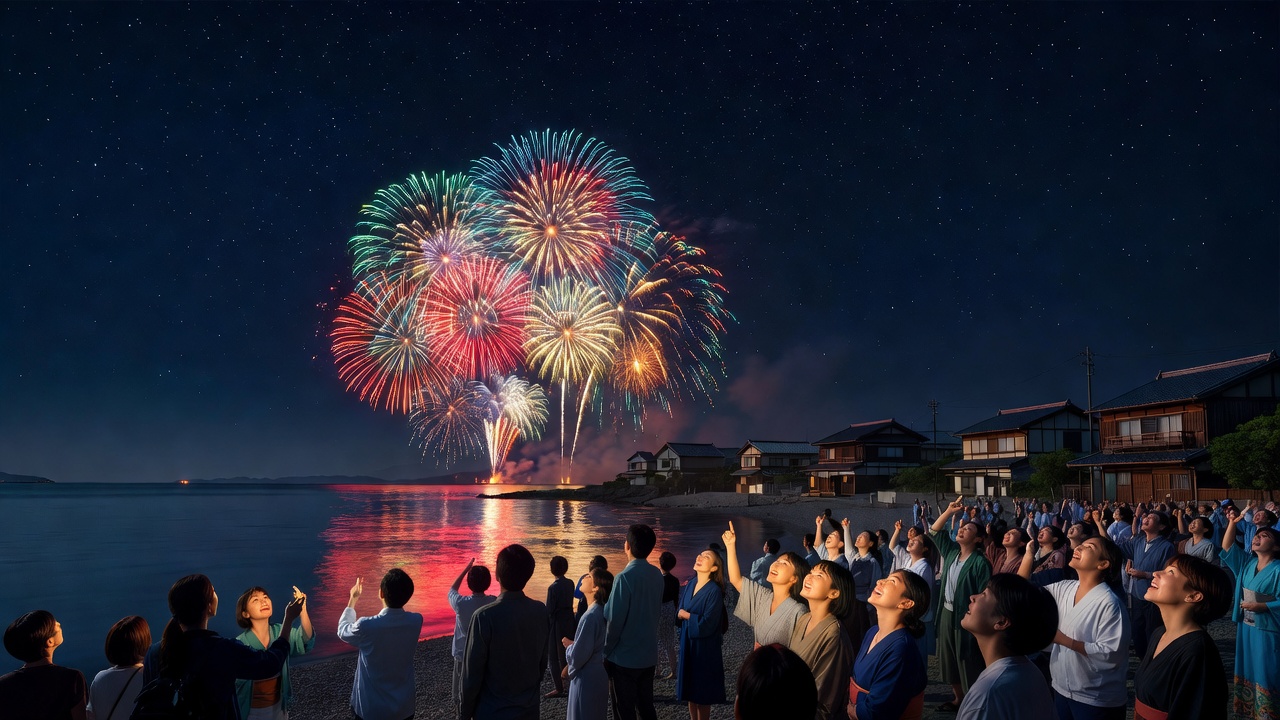
At the coast of Ujina, 500 drones rose into the night sky, painting pictures of light for about 15 minutes. Thousands of people looked up as the drones maintained a distance of just a few meters from each other. Coordinate data assigned to each drone continued to be sent from operators on the ground.
On the eastern side of the Futabayama Tunnel on the Hiroshima Expressway No. 5, a 36-meter-long and approximately 36-ton bridge beam was connected to an existing elevated structure in just a few hours during the night. If this work were to be done during the day, a complete closure of the general road running beneath it would be necessary.
In recent months, “large movements at night” have visibly increased in Hiroshima. Pedestrian bridges, drones, bridge beams—though these events seem to vary in scale and purpose, they share a common structure. It’s a story about how “the night takes on the responsibility of not halting the urban functions of the day.”
Nighttime Arrangements to Avoid Halting the Day
Why was the installation of the pedestrian bridge in front of Kure Station done at midnight? The answer is simple: since a structure is being erected over a national highway, the lanes must be blocked to carry out the work. National Route 31 in front of Kure Station is a major road with a daily traffic volume of about 20,000 vehicles, and a complete closure during the day would cause traffic jams to spill over into surrounding residential roads. The time frame from 1 AM to 5 AM sees traffic drop to less than one-tenth of daytime levels. During this “blank four hours,” the 53 tons are lifted, installed, bolts are tightened, and the road is reopened—everything is meticulously planned in reverse.
The connection of the bridge beam on the Hiroshima Expressway No. 5 operates under the same dynamics. Construction work on highways must always calculate its relationship with the general roads directly below and surrounding it. Lifting a 36-meter bridge beam with a crane requires not only securing a working radius but also establishing a safety zone to prepare for any potential drop risks. If this were done during the day, the impact area would expand many times over. By choosing nighttime construction, the scope and duration of road closures can be minimized. This is often brushed aside with the phrase “consideration for residents,” but the reality is much more specific. The construction specifications detail permitted closure times, maximum noise and vibration levels, and methods for notifying nearby residents in advance. Working at night is not an act of goodwill; it is a design choice.
The costs of nighttime construction are higher than during the day. Night shift allowances, additional lighting equipment, and increased security personnel—generally, nighttime work is said to cost 1.3 to 1.5 times more than daytime work. Nonetheless, the choice of night is made because the economic losses from daytime traffic disruptions and the overall cost increases due to prolonged construction periods are greater. In other words, the decision to “move at night” is backed by calculations weighing the time and costs for the entire city.
A Different Reason for 500 Drones to Choose Night
The reason drone shows are held at night differs slightly from construction. Of course, the most significant visual reason is that “light displays shine best against a dark sky.” However, it’s not just that.
To fly 500 drones simultaneously, all units must be connected to the same control system and receive real-time coordinate instructions. The frequency band used must be coordinated in advance with the Ministry of Internal Affairs and Communications to avoid interference with other wireless communications—such as mobile phone base stations, business radios, and Wi-Fi. In urban areas, the radio environment becomes complex during the day, so the reduced communication traffic at night enhances control stability. If even one of the 500 drones loses control, it directly impacts the safety of the audience. Choosing night is not only for the sake of the performance but also part of the safety design.
Furthermore, there are relationships with aviation laws. Drone flights require permission and approval from the Ministry of Land, Infrastructure, Transport and Tourism, and it is easier to obtain permission during times when manned aircraft are less active. The selection of Ujina Coast as a location also meets multiple conditions, such as being outside the approach path of the airport and being open to the sea to minimize damage in case of a drop.
The 15-minute light show that the audience gazed at was backed by a bundle of arrangements made months in advance, including radio adjustments, aviation law permit applications, drop simulations, wind speed threshold settings, and flowcharts for making cancellation decisions. Behind the dazzling night sky lies a thick layer of mundane paperwork and adjustments. It’s worth taking a moment to acknowledge that.
The Structure of the ‘Night City’ Becomes Visible
When we line up these three events, a certain structure emerges.
Daytime Hiroshima is a time when people move, the economy circulates, and daily life is conducted. If any of these functions were to stop for even an hour, the repercussions would spread in a chain reaction. Therefore, the work of updating the city’s framework—installing infrastructure, large-scale spatial productions—gets pushed into the night when the functions of the day are asleep. Night is not a “time of nothingness”; it is a time when the city operates behind the scenes to maintain the day.
This structure is not unique to Hiroshima. Nighttime maintenance and updates are also carried out on the Tokyo Metropolitan Expressway and Osaka’s subway. However, what has happened in Hiroshima over the past few months appears somewhat special because the different genres of “night work”—pedestrian bridges, drones, and bridge beams—overlapped almost simultaneously. Each department in charge, each client, and each purpose is different. Nevertheless, they all operate during the same time frame under the same constraint of “not halting the day.” The significance of the role that night plays within the urban system has been made visible through this coincidental overlap.
Who Supports the Night?
Finally, I want to shift the perspective slightly.
The crane operator lifting 53 tons at 1 AM. The engineer staring at the control screen of 500 drones. The steelworker passing bolts through the joints of a 36-meter bridge beam. They are the ones fitting the last pieces into the infrastructure that will be used as if nothing had happened by morning.
People crossing the pedestrian bridge during the morning commute are unaware that it was erected just four hours earlier. Drivers on the highway pass over the bridge beam that was connected the previous night without realizing it. Only the audience of the drone show may say they “saw” the nighttime work—but what they saw was light, not the underlying radio adjustments or safety designs.
The large movements at night in the city dissolve into the landscape come morning. This is also proof that the system is functioning well. The invisibility of these operations is a condition for success.
That is why I want to document it. Who moved what in the night of Hiroshima? To capture even a bit of the warmth of the hands that support the daytime city.


 JA
JA EN
EN