



What Happened on a Closed Mount Fuji? The Hidden Truth Behind a Fatal Fall

Related Articles
“I Can’t Move—My Right Leg Hurts”: A Desperate Emergency Call and the Reality of a Frozen Slope
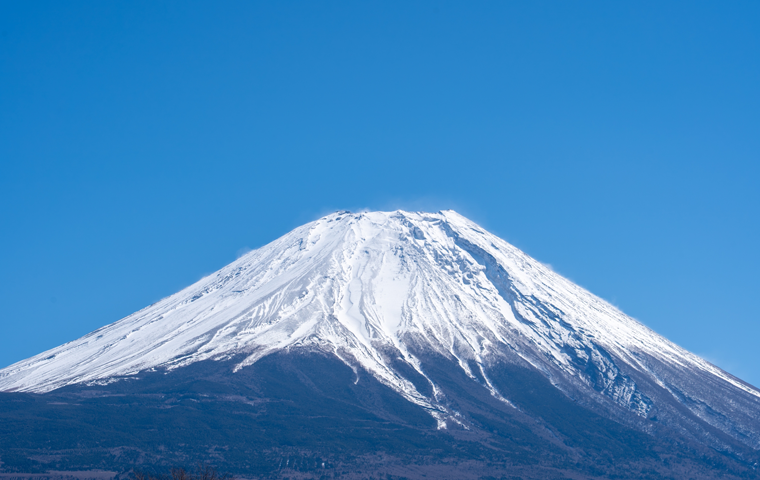
On December 29, 2025, while the rest of Japan was wrapped in the calm atmosphere of the year’s end, a tragic accident occurred on Mount Fuji, the nation’s most iconic symbol. Just before noon, at approximately 11:55 a.m., emergency services received a distress call from the area around the “New Seventh Station” on the Fujinomiya Route on the Shizuoka side, at an elevation of about 2,780 meters.
“I slipped and fell. My right leg hurts and I can’t move.”
The caller was Toshiyuki Sugita, a 44-year-old man visiting from Kamikawa Town, Hyogo Prefecture. At that moment, he was standing on the very edge of death in a world of extreme cold nearing minus 20 degrees Celsius.
Mr. Sugita was not climbing alone. He had entered the mountain with two friends, forming a party of three. They had begun their ascent not on the morning of the accident, but the day before, on the 28th. This means they spent a brutal night on Mount Fuji during the dead of winter—a season when no mountain huts are open—likely relying on a tent, a snow cave, or an improvised bivouac near a shelter.
On the 29th, it remains unclear whether they successfully reached the summit or turned back due to worsening weather. What is certain is that the accident occurred just as they had begun their descent. The location was about 200 meters south of Goraiko Sanso, an area that bustles with climbers during the summer season. In winter, however, this same place becomes a completely different world. Mr. Sugita lost his balance and slid down an astonishing distance of 200 to 300 meters.
At the time of the emergency call, he was conscious and able to speak, responding to police inquiries. But on Mount Fuji in winter, being “unable to move” is essentially a death sentence. As an isolated peak, the mountain offers no shelter from the wind. On that day, the minimum temperature near the summit dropped to minus 19.8 degrees Celsius, with violent winds exceeding 20 meters per second. The wind chill would have pushed the perceived temperature to somewhere between minus 30 and minus 40 degrees.
In such conditions, even the most advanced cold-weather gear cannot prevent rapid heat loss without continuous movement. When rescue teams finally reached him after a desperate effort, Mr. Sugita was already in cardiac arrest. Although he was transferred to an ambulance waiting at the fifth station, his death was confirmed. In the few hours after his call—when he should still have been conscious—he must have faced not only severe injuries, but also a bone-freezing solitude and despair.
The “White Devil”: Blue Ice and the Physics of a Fall That Cannot Be Stopped
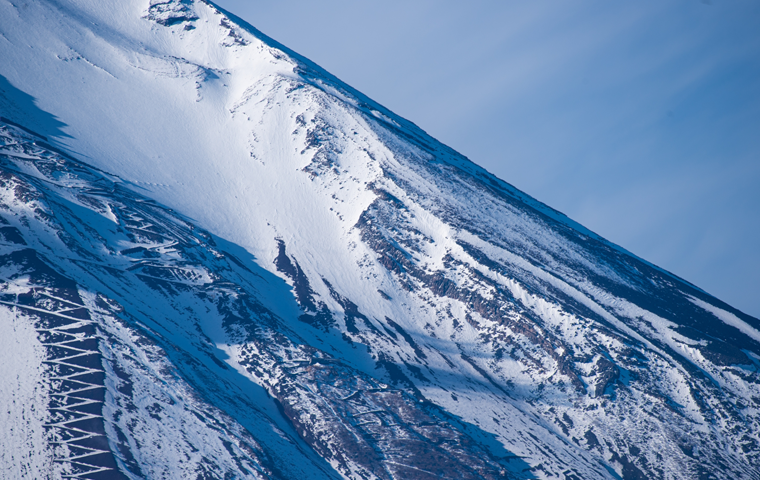
Why was Mr. Sugita unable to stop himself after falling as much as 300 meters? The answer lies in a surface condition unique to Mount Fuji in winter, commonly known as “blue ice.”
When people imagine winter mountains, they often picture soft, powdery snow. Mount Fuji, however, is different. Moist winds from the Sea of Japan deposit snow, which melts under daytime sunlight, then refreezes at night under extreme cold and fierce winds. Repeating this cycle transforms the mountainside into a thick, blue-glinting armor of ice rather than snow. This is blue ice.
Blue ice is said to be as hard as concrete. Slopes that would normally be cushioned by gravel in summer become, in winter, like a massive skating rink tilted at a 45-degree angle. On this surface, even mountaineering boots—and sometimes even standard crampons—cannot gain purchase simply by stepping down. Climbers must drive their full body weight into the ice, kicking hard enough to break it and force the metal points to bite.
Descending is especially dangerous. If a fatigued climber misjudges their footing for even a moment, their body is instantly launched into the air. Once sliding begins, the coefficient of friction drops to nearly zero. A human body becomes nothing more than an object accelerating under gravity, hurtling downhill at tens of kilometers per hour, smashing into rocks along the way.
Mountaineering manuals describe a self-arrest technique using an ice axe to stop a fall. However, on the blue ice of Mount Fuji in winter, this technique is nearly useless. Even a steel ice axe, driven with all one’s strength, often bounces off ice that is simply too hard. The horrifying fall distance of 300 meters suggests that Mr. Sugita desperately attempted to stop himself, only to be denied by the unforgiving slope.
The Fujinomiya Route has many exposed rocky areas. Colliding with rocks at high speed almost inevitably causes fractures and internal injuries. The “pain in my right leg” that Mr. Sugita reported was likely a severe fracture caused by the impact—an injury that robbed him of mobility and became the decisive factor leading to death from hypothermia.
The Paradox of the 2025 “Climbing Restrictions” and What Lies Beyond the Closed Gates
Behind this tragedy lies a complex relationship between the new Mount Fuji climbing regulations introduced in 2025 and winter climbing, which falls outside their scope.
This year, Yamanashi and Shizuoka prefectures introduced mandatory trail fees and gated entry restrictions to combat overtourism and discourage so-called “bullet climbing,” where climbers attempt the summit in a single push without staying in mountain huts. While these measures proved somewhat effective during the summer season, they were lifted once the mountain officially closed on September 10.
As a result, the most dangerous season—winter—has effectively become a “management vacuum.” Access roads such as the Fuji Skyline are closed, preventing vehicles from reaching the fifth station. Barricades and signs reading “Road Closed” and “Climbing Prohibited” are posted at trailheads. However, under Japan’s legal system, it is difficult to physically seal off trails or punish those who ignore the warnings.
Authorities issue strong advisories, stating that climbing without proper preparation is prohibited, but in practice, responsibility is ultimately left to the climbers themselves. Ironically, some experienced climbers—and some foreign visitors—appear to be deliberately choosing the closed season, seeking tranquility or “freedom without restrictions” away from crowded summer routes.
During the 2025 season alone, multiple accidents occurred after the official closure. In December, a Chinese university student in their 20s required rescue twice within a single week. A woman from the United States and a man from South Korea also requested rescue in separate incidents. In some cases, climbers appeared to underestimate the dangers of winter, treating the mountain as if it were simply an extension of the summer season.
There were even cases of ad-hoc climbing parties formed via social media becoming separated and lost. On a closed Mount Fuji, all infrastructure is shut down: no huts, limited phone reception, not even functioning toilets. When accidents occur under these conditions, rescue teams must risk their own lives, exposing themselves to the danger of secondary accidents. Beyond the closed gates lies a heavy social cost and risk that cannot be dismissed by the phrase “personal responsibility.”
Reclaiming a Sense of Awe: The Courage to Turn Back Demanded by a Precious Loss
The death of Toshiyuki Sugita forces us to confront, once again, the need for reverence toward nature. Modern mountaineering gear is highly advanced, and GPS apps make it easy to know one’s location. Yet no amount of technology can neutralize the physical threats of minus-20-degree temperatures, violent winds, and steel-hard ice slopes. Humans, in the face of nature, remain fragile beings.
This accident was not the result of a reckless beginner’s mistake. Even a party that entered the mountain the day before, equipped and planned to a certain degree, was brought down by a single misstep. It starkly illustrates how unforgiving winter mountaineering truly is.
Risk management during descent is especially critical. If climbers exhaust themselves on the ascent, they lose the strength needed to control their footing on icy slopes during the most dangerous phase—the way down. Reaching the summit is only half the goal of mountaineering; a climb is successful only when one returns safely.
In this case, we may never know whether worsening weather, fatigue, or a momentary lapse in concentration was the direct cause. But on Mount Fuji in winter, decisions such as “turn back if unsure” or “wait it out if the weather looks dangerous” represent the ultimate dividing line between life and death.
Looking toward 2026, authorities and mountaineering organizations must go beyond simple “No Entry” signs and provide clearer, more impactful, multilingual warnings. How realistically can they convey the message that “if you fall here, you will not survive” or “rescue may not come”? At the same time, climbers and the media share a responsibility to recognize and communicate the deadly reality hidden behind Mount Fuji’s beautiful winter scenery.
To ensure that Mr. Sugita’s death was not in vain, we must discourage casual winter ascents and continue questioning what “true personal responsibility” really means. Winter Mount Fuji is beautiful, majestic—and relentlessly cruel, a realm that belongs to the gods alone.