



The Disappearance of Service Points and the Integration of Hospitals: A New Map of Retreat in the Setouchi Region

Related Articles
The Disappearance of Service Points and the Integration of Hospitals: A New Map of Retreat in the Setouchi Region
The “Midori no Madoguchi” at JR Kure Station is closing. Two hospitals in Innoshima are merging into one. A variety store in the Kure Station building is shutting down, and a cinema that has been in operation for nearly 80 years in front of Fukuyama Station is closing its doors—none of these events are significant enough to make national news. However, when these occurrences are laid out on a single map of Setouchi, a certain outline begins to emerge. The “retreat” is not happening in isolation; the same structural forces are simultaneously eroding the ground in multiple locations.
What I want to ask is not “why did they disappear?” but rather, after they are gone, who will take on what responsibilities—can we see the blueprint for that?
When Service Points Close, What Replaces “Face-to-Face” Interaction?
The “Midori no Madoguchi” at JR Kure Station will close at the end of next month. JR West Japan has been gradually reducing its service points over the past few years, and it is projected that the number of staffed service points, which was about 340 in fiscal year 2020, will decrease to around 100 by fiscal year 2025. Kure Station is part of this trend. The background to this is the proliferation of online reservations. The usage of JR West Japan’s “e5489” and “EX Service” has been increasing year by year, and the demand for ticket issuance at service points is certainly dwindling.
However, there is a reality that cannot be explained by numbers alone. The aging rate in Kure City is about 36%. Even among those who own smartphones, there are many who are not accustomed to operating reservation apps. When the service point disappears, who will support those individuals in the act of “buying a ticket”? Some stations are introducing “talking reserved seat ticket vending machines,” but communication with operators is only through a screen. The time spent consulting while spreading out a map and saying, “I want to go here,” was an infrastructure of trust that existed outside of efficiency.
The closure of the service point can be understood as a rational decision by the JR corporation. The issue lies in how to incorporate those who are not reached by that rationality into the design.
Two Hospitals Merge: What Innoshima’s Healthcare is Betting On
In Innoshima, the Innoshima Medical Association Hospital and the Innoshima General Hospital have merged, and a new system has begun to take shape. The Innoshima General Hospital had serious issues with aging infrastructure, with some buildings not meeting seismic standards. The merger has consolidated emergency services and outpatient functions at the Innoshima Medical Association Hospital, which will also take over dialysis treatments.
Innoshima has a population of about 21,000. Once prosperous due to shipbuilding, the island is now facing simultaneous population decline and aging, making it difficult to secure enough patients and medical staff to maintain two hospitals. The merger is a result of choosing “sustainability through consolidation” rather than mere “reduction.”
What is noteworthy here is the design philosophy post-merger. By consolidating emergency and outpatient services in one location, the efficiency of physician and nurse placement increases. For dialysis patients, there is a burden of changing their familiar location, but a system has been secured that ensures treatment does not get interrupted. In other words, the priority of “what to retain” has been clearly designed.
However, while Innoshima is connected to the mainland by a bridge, it still faces geographical constraints as an island. The means of transportation to the merged hospital—such as the frequency of buses, the number of taxis, and the availability of shuttle services—becomes a practical bottleneck for medical access. The integration of hospitals cannot be resolved solely by addressing building issues. Only when the transportation system is included can we truly say that “the integration has been successful.”
What is Lost When an 80-Year-Old Cinema Closes?
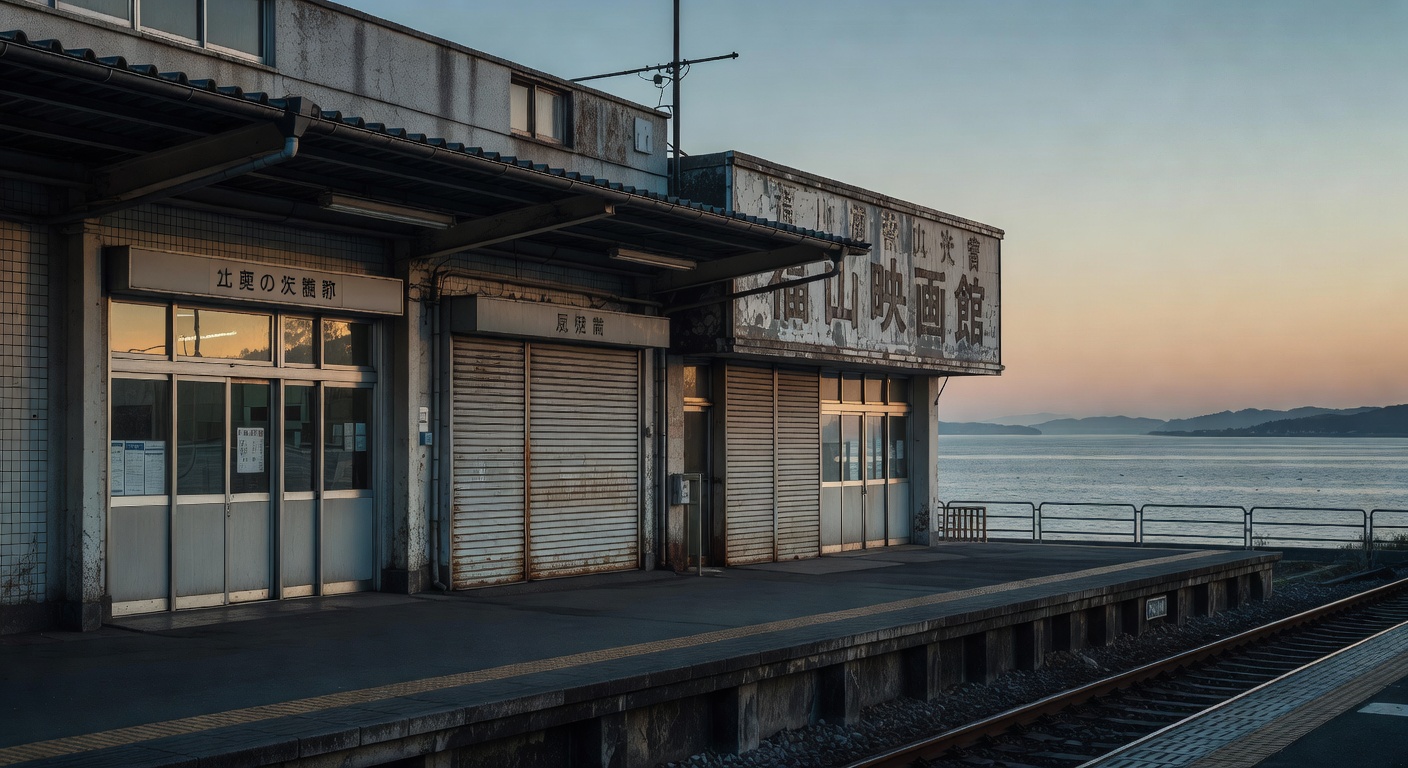
The cinema “Cinema Mode” in front of Fukuyama Station is closing. Since its opening in 1948, it has supported Fukuyama’s film culture for about 77 years. The rise of multiplex cinemas, the proliferation of streaming services, and the aging of the building—these reasons for closure are complex, but they all stem from a diminishing need for “this place to exist.”
The closure of the variety store “Salad Bowl Kure Crest Store” in the Kure Station building can be understood in the same context. The location of the station building was once a nexus of human flow. However, as the number of station users decreases and the commercial appeal of the facility wanes, tenants withdraw. What remains are vacant spaces and the memories of those who frequented them.
I want to take a moment to reflect on the closure of Cinema Mode. A cinema is not only a place to watch movies but also a space to share time with others in the dark. The same films can be watched via streaming. However, the shared sensation of holding one’s breath at the same scene with a stranger—this shared experience disappears along with the building. This is a loss that cannot be measured by efficiency.
Common Structures in the Map of “Retreat”
When these events are lined up, a common structure becomes visible.
First, the number of users has fallen below a threshold. Without a certain number of users, it is impossible to justify the maintenance costs of service points, hospitals, or cinemas. In the Setouchi region, where population decline and aging are advancing, facilities that fall below that threshold will likely continue to increase.
Second, it is assumed that there are alternative means. There are apps for service points, alternative hospitals, and streaming for cinemas. However, the uneven access to these alternatives skews the pain of retreat. For those accustomed to digital solutions, changes that do not cause “inconvenience” can result in “disruption of life” for those who are not.
Third, the decisions to retreat are individually optimal, but the impacts ripple throughout the entire region. The closure of JR service points is a management decision by JR, the integration of hospitals is a reorganization of the medical area, and the closure of cinemas is a business decision by private enterprises. Each has its own rationality. However, when these events occur simultaneously in the same region, the message residents receive is a sense that “this town is shrinking.” That feeling can lead to a negative loop that invites further population outflow.
What to Design After Retreat
The word “retreat” carries a backward-looking connotation. However, as demonstrated by the merger of hospitals in Innoshima, retreat is also an act of “choosing what to retain.” The question is whether that choice is intentionally designed or occurs by chance.
The map of Setouchi is quietly being redrawn. What functions will replace the service points at stations that have disappeared? How will the transportation system change on an island where hospitals have merged? Will new reasons for people to gather emerge in front of a station where a cinema has closed?
Retreat is not the end. However, if nothing is designed after the retreat, it will indeed become a true ending.
What will draw the new map of Setouchi is not the voices lamenting what has disappeared, but the concrete actions of deciding how to use what remains for whom.


 JA
JA EN
EN